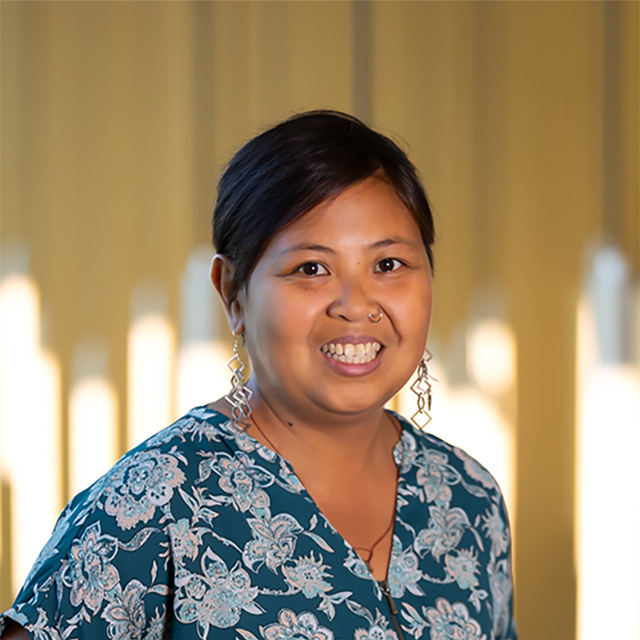
Associate Professor of Psychology and Neuroscience
Psychology
Hillyer College of Arts and Sciencestarampi@hartford.edu 860.768.5148 E 203K Spatial Cognition and Physical Environments (SCaPE) Laboratory
Education
PhD, University of Utah
MS, University of Utah
BArch, Carnegie Mellon University
Margaret R. Tarampi, PhD is an Associate Professor of Psychology and Neuroscience. Her Spatial Cognition and Physical Environments (SCaPE) Laboratory investigates the cognitive mechanisms that underlie space perception and spatial cognition in select populations including visually impaired individuals and spatial experts such as dancers and architects. Other research interests include spatial thinking, perception and action, perspective taking, crowd dynamics, joint action, and kinesthetic imagery.
Tarampi cultivates a unique approach to her research and teaching that is truly interdisciplinary. She graduated from Carnegie Mellon University with a Bachelor of Architecture. Her interests in the effect of architecture on quality of life brought her to the American Institute of Architects National Headquarters in Washington DC, then to the Salk Institute for Biological Studies in La Jolla CA. Tarampi received her Master of Science and Ph.D. in Cognition and Neural Science from University of Utah. Following her graduate training, she was a Junior Research Fellow in the SAGE Center for the Study of the Mind and a Research Associate in the Center for Spatial Studies both at University of California Santa Barbara. Tarampi is also an accomplished visual artist whose work explores assumptions and manipulations of the human perceptual system. Her art and architecture work has been displayed in exhibitions nationally and internationally.
Tarampi currently serves as the President of the Academy of Neuroscience for Architecture. She received the 2022-23 College of Arts and Sciences Outstanding Faculty Award and a 2022 Laura Johnson Leadership Award.
This faculty member will be on sabbatical for both Fall 2026 and Spring 2027. During a sabbatical, faculty may not be available to support students or conduct other University business.