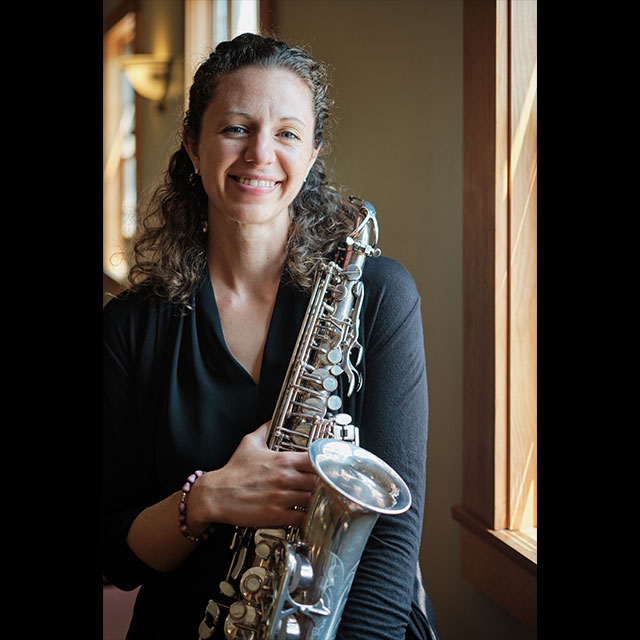
Saxophone Instruction; Coordinator: Early Childhood Music Education; First Steps in Music Instruction; Department Head: Winds and Brass (HCD)
HCD Music
kokus@hartford.edu https://www.foundryquartet.com
Education
BS Music Education with Honors, The Pennsylvania State University
MM Saxophone Performance, The Hartt School
CT Teaching Certificate (049)
First Steps in Music certification, Feierabend Association for Music Education
Mallory Kokus is a freelance performer and teacher specializing in both saxophone and early childhood music education. At the Hartt Community Division, she teaches saxophone lessons and early childhood music classes and serves as Chair of the Winds and Brass Department. Additionally, she is the instructor of saxophone at CT State Community College Manchester and adjunct professor of music education at The Hartt School.
In addition to her work as an educator, Mallory maintains a busy performing schedule. She is a founding member of Foundry Saxophone Quartet and currently holds the alto saxophone chair. She has extensive experience as a woodwind doubler and has performed on flute, clarinet, and saxophone at such theaters as Goodspeed Opera House, Playhouse on Park, Ivoryton Playhouse, and Sharon Playhouse. She also plays tenor saxophone with Flamingo Big Band, a 15-piece all-female jazz band based in northeast CT.
It wasn’t until she had her own babies that Mallory became interested in early childhood music. She completed her First Steps in Music training with Connie Greenwood in 2018 and has been teaching classes ever since. She regularly teaches parent-child classes at Hartt Community Division and AHM Youth and Family Services (Hebron). She also has partnerships with the Charter Oak Cultural Center (Hartford), Wethersfield Public Library, and Middletown Adult Education. Mallory is also the music teacher at Quaker Lane Cooperative Nursery School (West Hartford).
Originally from Doylestown, PA, Mallory now lives in East Hampton, CT with her husband and three children.
Follow her on Facebook at @MusicwithMallory
Private lessons are a unique and special opportunity for both student and teacher. Private teachers are able to get to know their students and families, which fosters strong connections and allows the teacher to tailor the lesson experience for every student. I strive to meet my students where they are musically, then help them develop the skills to continue their growth.
I am always sure to focus on the fundamentals in my private teaching. This includes the fundamentals of good saxophone playing like proper embouchure formation, articulation, breathing, and air support. These topics can be difficult to address thoroughly in a student’s school band program. I also emphasize the fundamentals of music, such as aural skills, basic music theory, and rhythmic accuracy.
My students all work on a variety of repertoire. I utilize etudes and method books in both classical and jazz styles as well as transcription assignments. I love to incorporate duets into my teaching; duets are a wonderful way to work on intonation, phrasing, style, and ensemble playing. My students work on solo pieces as well, and I encourage all of them to perform in studio recitals. Solo performance is so different from playing with your school band! It can be scary and nerve wracking at first, but the thrill and joy of playing a solo piece for an audience is unparalleled.
Though I expect my students to learn a great deal and perform at a high level, it is unrealistic to assume that more than a few of them will pursue music as a career. As a private lesson teacher, my goal is to develop well-rounded, resilient students with a firm understanding of the basic concepts of music. I hope my students will continue to appreciate music into adulthood, seeking it out as an audience member (live concerts or recordings) and as a participant (performing with community bands or just playing for fun). I also hope that they will support and advocate for music in schools, ensuring that their children also get the opportunity to develop into musical people and appreciate this unique aspect of the human experience