Join us to hear form noted authorities from around the country as they present recent research on video game music from 12:45 p.m. to 2 p.m. on Wednesday, April 8 in Allen Library (HJG L132 - Allen Library Large Seminar Room).
To attend in-person or virtually, RSVP by 6 p.m. on Tuesday, April 7 by emailing Professor Ken Nott at nott@hartford.edu.
Presentations:
"To Smother Your Furies and Banish Your Fears..." — Trauma, Psychosis, and Empathetic Engagement in the Music of the Hellblade Games with Dana Plank
Dana Plank is an independent scholar and the editor-in-chief of the Journal of Sound and Music in Games whose work focuses on intersections of music and representations of identity, particularly video game sound and gender, sexuality, and disability. She serves on the boards for Game Sound Con and the North American Conference on Video Game Music.

In addition to her scholarship, she is active as a freelance violinist and violist, chamber musician, transcriptionist, arranger, and Twitch streamer, co-hosting a weekly stream on video-game music with Ryan Thompson, Julianne Grasso, and Karen Cook on Thursdays at 9 p.m. Eastern at twitch.tv/bardicknowledge.
Abstract:
Hellblade: Senua’s Sacrifice (Ninja Theory, 2017) follows a Pict warrior on her quest to recover the soul of her dead lover. Senua is joined by voices she calls the Furies that whisper constantly around her, urging her to turn back, encouraging her forward. Audio team David García and Andy LaPlegua utilized binaural audio techniques to simulate a three-dimensional space, rendering the experience more immediate and visceral. The rich timbral textures of the musical score place particular emphasis on the blurring of the line between sound design and musical composition through vocal writing, synthetic noise, echo, and distortion. The resultant soundscape envelops the player in Senua’s recurring traumatic flashbacks and/or schizoaffective disorder symptoms and makes the player question their ability to distinguish underscore from diegesis, atmosphere from information. Senua’s Saga: Hellblade II (2024), with music by García and Scandinavian experimental folk trio Heilung, focused on Senua’s path to healing from complex trauma.
In this talk, I explore these games’ evocative soundscapes through the lens of music, disability studies, and trauma, demonstrating how the scores' emphases on stasis, fragmentation, and reverberation serve to characterize Senua’s traumatic experiences as a disruption of normative time; situate the games' hallucinatory interjections into the soundscape through the voices of the Furies; and to reflect on the games' ultimate potential as persuasive media and a site of potential empathetic engagement. We cannot ever fully cross into another’s embodied experience (Ayers, 2021), but that doesn’t mean we can’t reach out a hand across the divide and be changed by the encounter itself.
"Koichi Sugiyama's Nine Topics across Nine Albums: The Scene-Separated Symphonic Suites" with Ryan Thompson
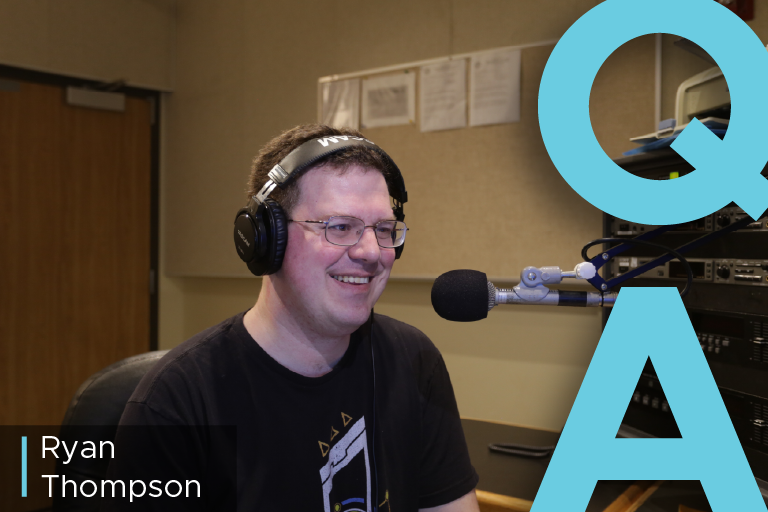
Ryan Thompson is an assistant professor in the Department of Media and Information, where he serves as the resident musicologist for the game development program, teaching and researching about a variety of issues related to sonic activity in video games. He received his PhD in musicology from the University of Minnesota in 2017. He has published on how gameplay is communicated to players via audio, on understanding Final Fantasy VI as opera, and currently researches how games are both scored and re-scored in order to channel a specific nostalgia for past generations of musical material and hardware as re-releases, remasters, and remakes continue to dominate discussion of popular culture.
Abstract:
In celebration of the 25th anniversary of the Dragon Quest franchise, a scene-separated edition (that is, separated by topic, not by game title) of the Symphonic Suites as recorded by the Tokyo Philharmonic was released as a limited edition set of 5,000. One of them recently came into my possession, and the ways in which this set of recordings are organized speaks to two ideas I intend to present alongside images of the set to accompany my arguments.
First, and most importantly: hearing these recordings as a set of nine albums covering nine games and nine musical topics (in order: overture, castle, town, field, cave, church, sky/ocean, battle, ending) places these pieces in immediate dialogue with one another at the level of the individual piece rather than at the level of the entire game soundtrack for which they were originally created. Of particular note is that Sugiyama has fully orchestrated the infamous “Overture” track nine different ways rather than simply reusing it across the titles, and the first disc opens with all nine of these tracks in succession. Second, review of the publication dates of the Dragon Quest games compared to the release of the Symphonic Suites (as one example, DQ3 was launched February 1988; DQ3 Symphonic Suite was released March 1988) suggest an opportunity for future research building an evidence-based argument that Sugiyama wrote the fully-orchestrated versions of these pieces first and converted them to NES format – opposite of most other composers’ approach to creating editions for orchestra.
Whither Ludomusicology? An Ethics of Inclusion and Acknowledgment with Karen M. Cook
Karen M. Cook is an associate professor and Chair of Music History and Director of Graduate Studies at The Hartt School. She specializes in the music, theory, and notation of the fourteenth and fifteenth centuries, and also in medievalism in contemporary music & media, especially video games, which is her secondary main area of research. She has presented her work at numerous national and international conferences, including the annual meetings of the American Musicological Society and the Society for Music Theory, the annual Medieval-Renaissance music conference, the International Congress on Medieval Studies at Kalamazoo, and the North American Conference on Video Game Music, for which she sits on the planning committee. In addition, she is a singer and performer of both early and contemporary music, and is routinely on the faculty and staff of Amherst Early Music, the largest presenter of early music workshops in North America.

Abstract:
By now, video game music scholarship is fairly cemented as one of the newer subfields of musicology, as conferences, numerous journals, and a considerable array of monographs and edited collections can attest. As this area has blossomed, it has often been called—by outsiders and insiders alike—ludomusicology, a term first utilized by Guillaume Laroche (see Tam) and Roger Moseley. Since the creation of the Ludo research group in 2011, the term has become indelibly linked to video game music studies. Yet, Moseley stretches beyond video games to explore the intersections of play and music from Ancient Greece to the present day—and he is not alone.
Scholarly work investigating music in games, as an element of game play, gamified sound, and the like has been done for decades prior to the invention of video games. Are those scholars, too, ‘ludomusicologists’? It is necessary to consider whether, by linking ‘ludomusicology’ almost exclusively to video game scholarship at the expense of scholars working on music games in the classroom (Adubato), or children’s playground songs and hand-clapping games (Gaunt), or musical mnemonic devices (Cade & Gunter), or even medieval musical games of citation (Plumley), the field has unnecessarily limited itself, and to its own detriment. A careful and deliberate re-definition of the term as an inclusive umbrella moving forward ethically includes and acknowledges that work alongside a decentered but no less valuable video game music scholarship.