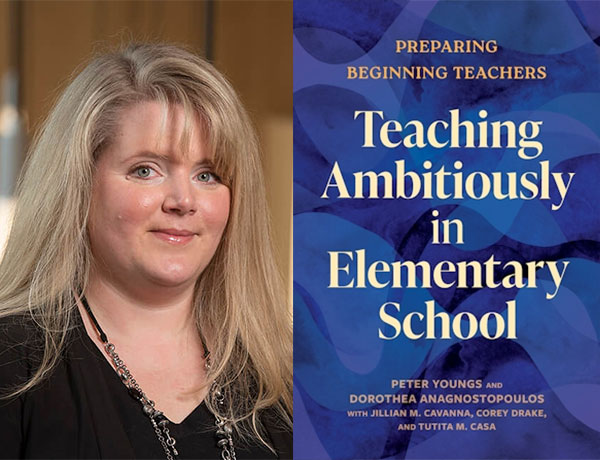
Associate Professor Jillian Cavanna, program director of early childhood and elementary education, is one of the authors of Teaching Ambitiously in Elementary School: Preparing Beginning Teachers. Aimed at undergraduates, the book promotes “ambitious instruction,” a student-centered educational approach which is far more robust than traditional approaches based around rote memorization.
The book focuses on new ways to engage students in mathematical thinking and reasoning, such as targeted assignments, tailored support, and skillful feedback to foster deep, conceptual learning. Cavanna says it’s a complex approach, but more important than ever before.
Associate Professor Jillian Cavanna, Program director of early childhood and elementary educationIt was a joy to collaborate on this book. Not often do we get to step back and take in the big picture of preparing teachers. It was a powerful experience to examine beginning teachers' trajectories as they moved from their preparation programs into their own classrooms.
"It was a joy to collaborate on this book,” she says. “Not often do we get to step back and take in the big picture of preparing teachers. It was a powerful experience to examine beginning teachers' trajectories as they moved from their preparation programs into their own classrooms.”
The book has received highly positive reviews since its publication in late 2025. One review, from a professor at the University of Utah, praises the research, saying it “provides extensive scholarship and stories of teachers that span multiple years and settings, adding a much-needed perspective to conversations about ambitious teacher preparation."
Cavanna is no stranger to research on ambitious instruction. She contributed to the books Beginning to Implement Ambitious Mathematics Instruction: What Promising First-Year Elementary Teachers' Lessons Can Teach Us and The Relationship Between Number Talks and Ambitious Instruction: Learning from Beginning Teachers, as well as several articles for teachers and school administrators.
“I'm pleased to have contributed to research that demonstrates we can offer beginning teachers effective tools to develop their skills,” Cavanna says. “It has helped me, too: now I regularly use this research in the work I do with my students at UHart.”