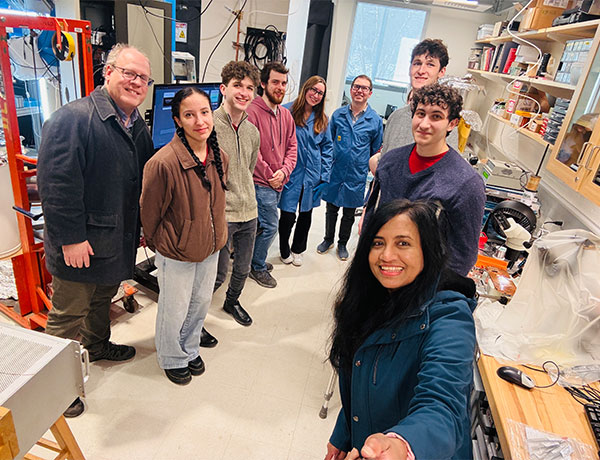
Organized by Professor Hashini Mohottala, the visit was designed to introduce undergraduate students to active research in both experimental and theoretical physics. While UHart does not currently offer a graduate program in physics, many of its students pursue advanced study after graduation, and alumni have gone on to programs across the country.
Four undergraduate physics majors and one graduate student—who had previously double-majored in mathematics and physics—participated in the trip.
Throughout the day, students toured five research groups spanning multiple areas of physics. They spoke directly with faculty and graduate researchers about ongoing projects, technical methods, and different career paths within the field.
“Experiences like this allow students to see how the theory they learn in class translates into real research,” says Mohottala. “It helps them envision themselves pursuing graduate study and contributing to scientific discovery.”
Inside the Research Labs
Students were introduced to work in theoretical physics, including studies of the strong nuclear force that binds subatomic particles. They learned how large-scale computational methods are used to model and better understand the structure of matter at its most fundamental level.
“I had a great experience,” says Valeria Colon ’27. “Before this visit, I thought I might be more of an experimentalist, but now I can see myself more as a theorist.”
They also explored experimental materials science research, where scientists synthesize and analyze advanced materials such as metal-oxide thin films. Students saw how researchers grow these materials and examine their properties using tools like X-ray diffraction, magnetometry, and high-resolution microscopy. They also learned about experiments conducted across extreme temperature ranges and in strong magnetic fields to investigate electronic and magnetic behavior.
Andrew Rittenberg ’27, College of Arts and SciencesGaining exposure to laboratory environments and having insightful conversations with researchers gave me a better understanding of the paths I might pursue after graduation.
From Black Holes to the Night Sky
Another highlight was exposure to astrophysics research focused on galaxies and supermassive black holes. Students observed a graduate-level research discussion, gaining insight into how scientists collaborate and exchange ideas.
The visit also included a planetarium session, where students experienced a guided exploration of constellations, galaxy structures, and the large-scale organization of the universe. For many, it connected their classroom learning to real astronomical observation and rekindled early curiosity about space.
Quantum Materials and Emerging Phenomena
Students were also introduced to research on quantum materials, including superconductors and other systems with unusual electronic and magnetic properties. They learned about advanced imaging techniques capable of detecting extremely small magnetic signals and how these tools are used to study complex physical phenomena.
A Glimpse of the Future
Participants said the experience helped clarify their academic and career interests. For Mohottala, the goal of the visit was to help students see themselves as part of the scientific community. She regularly incorporates such experiences into her capstone course.
“Physics is ultimately about curiosity-driven discovery,” she says. “When students step inside active research laboratories and interact with scientists, it helps them realize that they can be part of that process.”
By the end of the day, students left with a deeper appreciation for the breadth of modern physics—from quantum materials and particle theory to galaxies and black holes—and a clearer sense of their own potential paths forward.