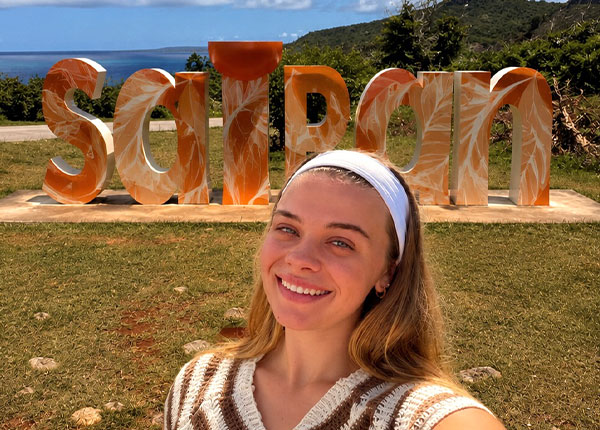
What she didn’t expect was to witness a community recovering from back-to-back natural disasters. Her work as part of a group of UHart students on the island would form lasting connections that would leave an unforgettable mark on her both professionally and personally.
Skillen, who is the president of UHart’s Physical Therapy Student Association, felt compelled to take part in the trip after hearing other students describe previous trips to Saipan and the meaningful relationships they had built within the island’s healthcare community.
“Knowing UHart students had already built trust and connection there made me want to contribute in my own way,” Skillen said. “I wanted to strengthen my confidence communicating with people from different cultural backgrounds, but more than anything, I wanted to listen to their stories and learn how to provide care that truly honors their culture and community.”
But the trip turned out far differently than planned. Just months before, Typhoon Sinlaku had devastated the island. Then, while UHart students were in Saipan, Typhoon Bavi forced an early evacuation, cutting their planned three-week experience to just a week and a half.
A Community Defined by Resilience
Despite the shortened timeline and extraordinary circumstances, the impact of the experience was profound.
“The entire island community was incredibly welcoming and appreciative, not only of our program, but of everyone supporting recovery efforts,” Skillen recalls. “People offered to open their homes to us, shared meals, and treated us like family after only a few minutes of conversation.”
Witnessing the island’s resilience in the wake of multiple storms was equally powerful.
“I didn’t expect to feel such a deep connection so quickly,” Skillen says. “I found myself smiling constantly while I was there, and even now, whenever I talk about Saipan, that same smile comes back. The community’s kindness and resilience are something I’ll never forget.”
Payton Skillen DPT ’27, College of Education, Nursing and Health ProfessionsIt’s a rare opportunity that very few programs offer. This experience strengthened my clinical decision-making, improved my communication skills, and broadened my understanding of what patient-centered care truly means.
Learning Beyond the Classroom
The storms meant many residents were navigating daily life with limited resources—so Skillen and the UHart team had to treat patients using items they already had at home.
“On the mainland, we often recommend something patients can order online, but in Saipan, an Amazon delivery can take weeks,” she says. “I learned to think creatively and meet patients where they are. Even when diagnoses are similar, treatment has to reflect a person’s culture, environment, and available resources.”
Many of Skillen’s patients were military veterans, which challenged Skillen to think differently, especially about communication.
“Their descriptions of pain were often communicated through facial expressions, changes in breathing, or movement rather than direct verbal statements,” she explains. “Learning to recognize those cues required a different level of attentiveness. It reminded me that communication isn’t just verbal. It’s relational and built on trust.”
By the end of the trip, Skillen says faculty members were pointing out changes in her own communication skills—and in her confidence. “They told me they could see a difference in my body language and the way I communicated with patients,” she says. “That helped me realize I know more than I often give myself credit for. Simply taking the time to listen and trusting my clinical abilities made all the difference.”
Listening became one of the most valuable clinical skills she developed.
“Understanding my patients’ daily routines and responsibilities helped shape my treatment approach more than any textbook could,” she says. “With limited time, I had to focus on education, so patients felt confident continuing their care after we left.”
Skillen is quick to credit UHart faculty members for ensuring students were well prepared long before they boarded the plane. Classroom discussion, led by a faculty member who had previously lived and practiced in Saipan, gave students valuable background on the island’s culture, health care system, and patient population.
“We felt supported every step of the way,” she says.
A Once-in-a-Lifetime Opportunity
For prospective students considering UHart’s Doctor of Physical Therapy program, Skillen’s message is simple: embrace opportunities that take you beyond the classroom.
“I would encourage anyone to participate without hesitation,” she says. “It’s a rare opportunity that very few programs offer. This experience strengthened my clinical decision-making, improved my communication skills, and broadened my understanding of what patient-centered care truly means.”
Even with a typhoon bearing down, Skillen says if she could do it all over again, she absolutely would.
“This experience reminded me why I chose physical therapy. To serve, to listen, and to connect,” Skillen reflects. “Saipan will always hold a special place in my heart.”