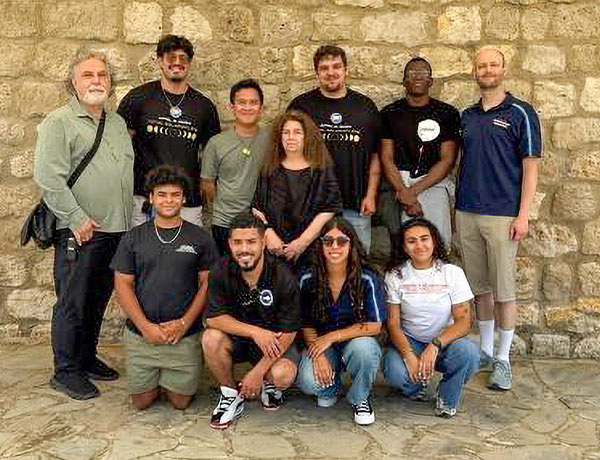
For University of Hartford student Javier Serrano ’27, those words took on new meaning this summer as he traveled to Spain to help conduct a NASA-supported eclipse research mission. Serrano, an electromechanical engineering technology major in the College of Engineering, Technology, and Architecture (CETA), joined fellow UHart student Brianna Montano-Vazquez ’27 and students from the University of Bridgeport as part of the Nationwide Eclipse Ballooning Project.
With funding provided by the NASA Connecticut Space Grant Consortium, the team spent approximately three months preparing for the mission, conducting test launches and developing the skills needed to successfully launch and recover two high-altitude balloons during the August 12 total solar eclipse. (Members of the team spoke with WFSB upon their return.)
The mission had several scientific goals: capture an image of the moon’s shadow on Earth, investigate whether the eclipse affects ozone levels, and measure solar radiation during totality. The team launched two payloads equipped with identical tracking systems and 360-degree cameras. One payload carried an ozone sensor, while the other carried equipment to measure solar radiation.
Javier Serrano ’27, Electromechanical engineering technology student, College of Engineering, Technology, and ArchitectureMy teammates were incredible. We really stayed in sync and kept things running smoothly. None of it would have come together without our professors, either. Their guidance and mentorship throughout the project meant a lot.
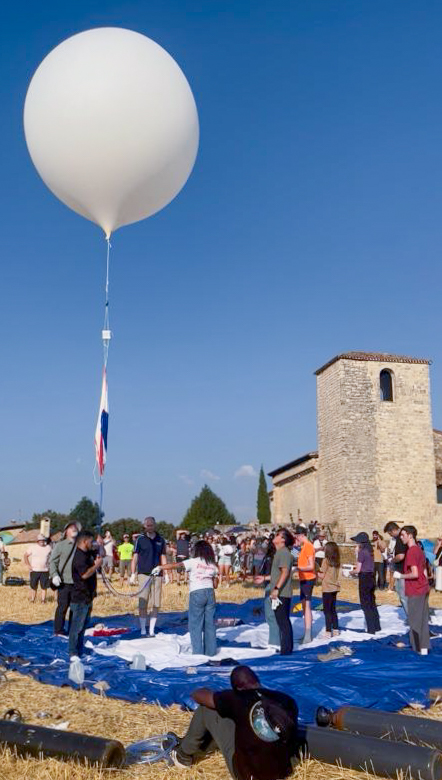 For Serrano, the project became an opportunity to take on responsibilities that grew throughout the summer. He began by learning the fundamentals of the tracking hardware used by the team. By the time the team arrived in Spain, he had become the Telemetry Officer, responsible for tracking the balloon during flight and helping recover the payloads after they landed.
He worked with APRS, SPOT Trace, and Iridium tracking systems, ran launch predictions to help determine the best launch location, and ultimately took the lead on helium fill operations.
The experience required more than technical knowledge. Working with students and faculty from two universities taught the team the importance of communication, trust, and flexibility, particularly when timelines were tight and plans changed at the last minute.
“My teammates were incredible,” Serrano said. “We really stayed in sync and kept things running smoothly. None of it would have come together without our professors, either. Their guidance and mentorship throughout the project meant a lot.”
The trip also offered an experience far beyond the science and engineering of the mission. Serrano said interacting with the local community in Spain was one of the highlights of the trip, describing the people he met as incredibly warm and welcoming. “It really felt like a once-in-a-lifetime opportunity, both scientifically and personally,” he said.
Now back at UHart, the team is continuing to analyze the data collected by both payloads and is building a presentation to showcase its findings. As for Serrano, he hopes to stay involved in future missions, potentially helping develop an ozone sensor or exploring how Starlink could be integrated with a Raspberry Pi to livestream a future eclipse directly from a balloon.
What began as a summer research project ultimately gave Serrano and his teammates the opportunity to put engineering principles into practice, collaborate across universities and cultures, contribute to scientific research, and turn a childhood ambition into reality.