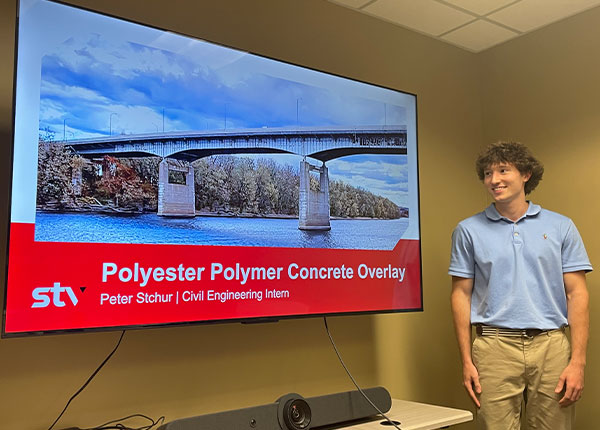
For Peter Stchur '28, studying civil engineering at the University of Hartford is about more than learning how things are built; it's about understanding how engineering shapes communities and the infrastructure they depend on.
"Ever since I was younger, whenever I saw a bridge or building, I wanted to know how it was designed and why it was designed that way," Peter says. "Another reason civil engineering appealed to me is its direct impact on developing communities and infrastructure."
During his time at the College of Engineering, Technology, and Architecture (CETA), Peter has developed the technical knowledge, communication skills, and discipline needed to take his interests into the workplace. His coursework has also pushed him outside his comfort zone, helping him become a stronger collaborator and communicator.
One of Peter's favorite UHart experiences came through ES242P, where he and his team won the sophomore CETA Design Expo for their weight-based inventory tracking system. The project featured interactive web interfaces and a hands-on demonstration, requiring countless hours of collaboration throughout the semester. "That project stands out to me," Peter notes. "Our team invested a significant amount of time in it, and working closely all semester made the result especially rewarding."
His classroom experiences have also taught him the value of honest feedback. In ES117 with CETA Dean Hisham Alnajjar, Peter was challenged to deliver a final presentation and received what he describes as "honest feedback." While difficult in the moment, the experience helped him recognize the importance of constructive criticism and communicating at a high level.
Peter Stchur ’28, Civil Engineering MajorPresenting regularly across my UHart courses gave me the confidence and experience to communicate effectively in a professional setting.
The ES242P course taught by Seong Hyun Moon, assistant professor of biomedical engineering, offered another opportunity to strengthen those skills through weekly status presentations and extensive feedback. "I was pushed as a student to meet high standards for presenting technical material clearly, and that has prepared me well for my career," Peter emphasizes.
That preparation paid off when Peter attended a UHart career fair during the fall of his sophomore year and received his first internship offer with STV. Over the summer, he worked with the company's Construction Engineering and Inspection (CE&I) team on the Putnam Memorial Bridge rehabilitation, gaining hands-on experience alongside engineers and inspectors.
Peter’s work included contract administration, abrasive blast cleaning and bridge painting, structural steel repairs, substructure repairs, and bridge deck rehabilitation. The experience gave him an opportunity to put his classroom learning into practice and to see firsthand what a career in civil engineering could look like.
Peter is continuing his internship with STV into the fall as a civil engineering intern with the CE&I team. He has already had opportunities to apply the communication skills he developed at UHart, including delivering a technical presentation on Polyester Polymer Concrete overlays to STV's design team. "Presenting regularly across my UHart courses gave me the confidence and experience to communicate effectively in a professional setting," Peter declares.
As he looks toward graduation in 2028, Peter hopes to build a career with a leading civil engineering design firm and contribute to new projects. As of this fall, he is also a student member of the Connecticut Chapters of the American Society of Civil Engineers and Construction Management Association of America.
His advice to incoming students is straightforward: "Develop good study habits and manage your time well. Stay involved in class and don’t be afraid to participate. What you get out of your education depends on what you put in."