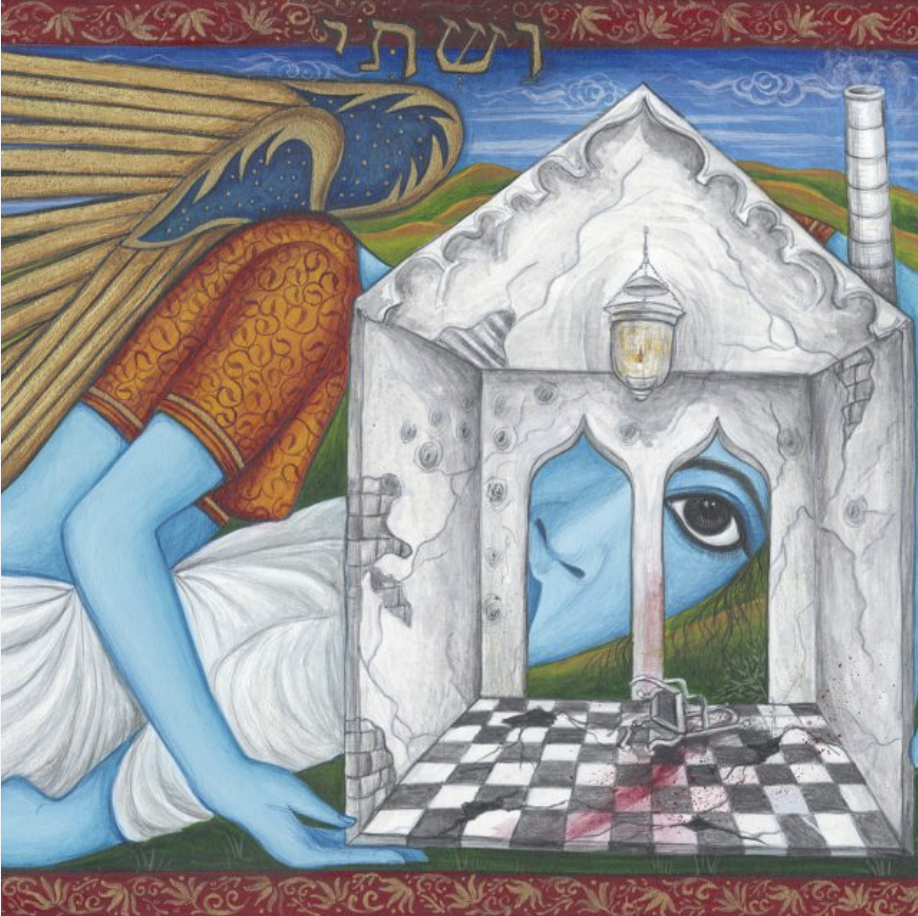
Art, like travel to foreign climes, challenges our notions of who we are and where we belong. We find ourselves destabilized when the syllables of an unknown language flow over us on a foreign city bus: still ourselves, but jostled into a new experience. It can be uncomfortable — what we thought was “normal” has been turned on its head, Alice-in-Wonderland style — yet also highly stimulating. Artist Siona Benjamin seeks out this “in between” in her life and art, which engages with her Jewish upbringing in a mainly Hindu and Muslim India. And she wants to talk about it. “Thinking in boxes doesn’t take you too far,” Benjamin mused at the opening of her University of Hartford exhibit in November. “I pitch my tent wherever I go. I find it liberating. I can identify with so many people.”
Join Benjamin and Greenberg Center Director, Amy Weiss, for a thought-provoking conversation about identity. How do we think past the “boxes,” the fixed notions of “us” and “them” that have reinforced so many entrenched political, racial, and religious divides — recently leading to everything from the longest U.S. government shutdown ever, to violations of the writ of habeus corpus for immigrants on U.S. soil, to devastating wars abroad? To what degree can thinking “outside the box” of identity help us push back at partisanship and polarization? And where does it remain critically important to stand our ground? How can we know where to draw the lines of belonging and where to let them go?
An Infinite Journey: The Art of Siona Benjamin will remain on view at the Museum of Jewish Civilization at the University of Hartford until April 30.
Siona Benjamin (MFA painting, SIU-Carbondale, IL; MFA theater set design, University of IL-Urbana/Campaign) is a Bene Israel Jew from India, now living in the United States, whose transcultural and multicultural art has been exhibited in the United States, Europe and Asia. She was awarded two Fulbright Fellowships, one to India in 2011 to India, and a second in 2016–17 to Israel. As not just a Jewish artist, but also as one who crosses cultural boundaries, she’s received praise in The New York Times, The Chicago Tribune, The Philadelphia Inquirer, The Financial Times, The Boston Globe, Art in America, Art New England, Art and Antiques, ArtNews, Moment magazine, The Times of India, The Mumbai Mirror, Marg Magazine, and other publications. Her multicultural art has also been featured in The Jewish Week in New York City and New Jersey, The Jerusalem Post, The Times of Israel, among others.
Amy Weiss is an Assistant Professor of Judaic Studies and History at the University of Hartford, where she also holds the Maurice Greenberg Chair for Judaic Studies. Most recently, she received a 2025–2026 Memorial Foundation for Jewish Culture Fellowship and a 2024 National Endowment for the Humanities Summer Stipend to assist with the completion of her first book Interfaith Friends and Ideological Foes: American Jews, Evangelicals, and Israel, 1963–2018 will be published by Oxford University Press in 2026. She is 2025–26 lead faculty fellow for the University of Hartford Humanities Center, where she is teaching a two-semester course on "AI in Action: The Future of Humans."
Tuesday, April 14 | 11 a.m.–12:15 p.m. | Greenberg Center/Harry Jack Gray Center | $20 for Non-Fellows
Free for Fellows, but we ask that you please register to attend.
Made possible in part by the generosity of the Richard P. Garmany Fund at the Hartford Foundation for Public Giving. Brought to you by the Presidents' College, where we connect the curious through lifelong learning.
For other stimulating Presidents' College offerings, see our printable PDF.
Faculty and staff are eligible to take one Presidents' College lecture for free every semester, or to receive a one-session discount ($20) for a longer course. Contact us at pcollege@hartford.edu or 860.768.4495.
Our snazzy Presidents’ College Gift Certificates are also ready for purchase. Giving the gift of knowledge is a great way to celebrate birthdays and un-birthdays in style while inviting friends and family into the Presidents' College circle.