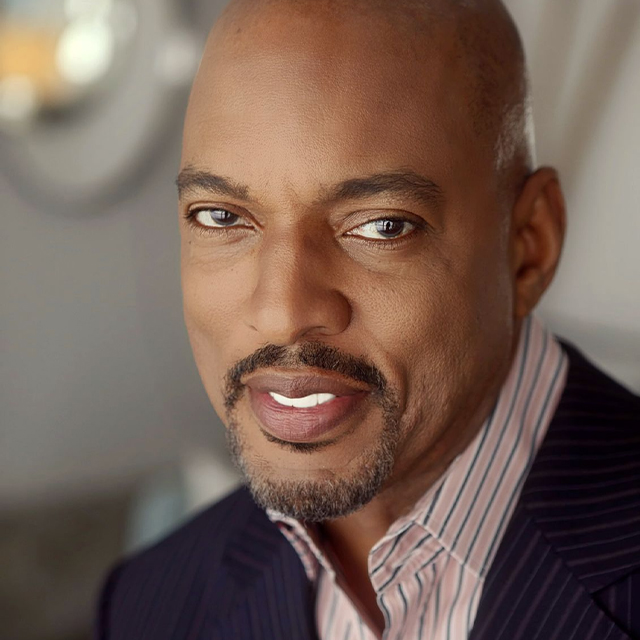
Assistant Professor of Theatre; Division Director of Theatre
Theatre
The Hartt Schoolkramsey@hartford.edu 860.768.2489 Handel Performing Arts Center - N 124 https://www.urbanmusicaltours.com
Education
Dillard University
NYU Tisch School of Arts
The New School
Professor Kevin Ramsey is an award-winning, multidisciplinary creative artist, scholar, educator, and Broadway veteran whose career encompasses theatre, film, television, new media, arts leadership, and cultural storytelling. He currently serves as Division Director of Theatre at The Hartt School at the University of Hartford, where he leads a nationally recognized conservatory theatre training program and advances interdisciplinary approaches to performance, scholarship, and creative innovation. A veteran of five Tony Award-winning and nominated Broadway productions, including The Life, Five Guys Named Moe, Oh, Kay!, Black and Blue, and The Lion King (1st National Tour/Los Angeles).
In film and television, he has appeared in Emmy-nominated series and major studio productions such as Cold Case, CSI: Miami, 24, The District, Trial by Jury, Night Falls on Manhattan, Saving Grace, Judging Amy, The Hughleys, and Charmed. As a voiceover artist, his work is featured in Ken Burns’ acclaimed documentary series The Civil War and Jazz. Professor Ramsey has received numerous honors, including the Theatre World Award, the Fred Astaire Award for Best New Talent on Broadway, the Outer Critics Circle Award, the Audelco Award, the Zoni Award, and the Barrymore Award, for his collaboration with Delaware Theatre Company in developing arts literacy programming for at-risk youth. He has also been recognized with the Tapology Legacy Award for his contributions to the preservation and advancement of tap dance.
As an internationally recognized performer and teaching artist, Ramsey has worked across Europe, Asia, the Caribbean, Germany, the Netherlands, Switzerland, and Japan. He performed to sold-out audiences as a featured vocalist and tap dancer with Skitch Henderson and the New York Pops Orchestra.
As a creative scholar, writer, and director, Professor Ramsey’s work centers on the historical examination, cultural preservation, and contemporary reimagining of the African American musical and theatrical experience. His scholarship and creative practice explore identity, memory, ritual, race, community, and the evolving role of storytelling in a hyper-mediated society. His work as an actor, writer, director, and creative producer has been presented on Broadway, Off-Broadway, at major regional theatres, and internationally. He is the co-author of the award-winning I Remember Harlem: A Tap Dance Tale. His other original works and commissions include Chasin’ Dem Blues: The Untold Story of Paramount Records, Sam Cooke: Forever Mr. Soul, Sirens of Song, Tap Rap, A Cappella Humana, Election Day, Thirst Trap, Soultime, and Fire on the Bayou. He is co-writer of the music/lyrics of Shakespeare’s R&J: Fire on the Bayou, a new musical that reimagines Romeo and Juliet during Mardi Gras in contemporary New Orleans, integrating Shakespearean language with hip-hop, jazz, gospel, and contemporary musical traditions from an African American perspective, and was recently selected and presented in Goodspeed Musical’s 2025 Festival of New Musicals.
Professor Ramsey also serves as Artistic Director of Hartford’s Got Talent, a citywide initiative dedicated to cultivating emerging artists, amplifying community voices, and expanding access to arts education and performance opportunities throughout Greater Hartford. Demonstrating a commitment to socially engaged storytelling and civic dialogue through the arts, he created and directs I AM HARTFORD: A Celebration of Diversity, a student-led film documentary and community initiative that highlights the voices, histories, and lived experiences of Hartford residents and University of Hartford students. The project integrates documentary filmmaking, oral history, performance, and community engagement to foster cross-cultural understanding and dialogue.
As an educator and curriculum innovator, Professor Ramsey has spent over eighteen years developing training models for 21st-century performing artists and storytellers. Before joining The Hartt School, he served as Senior Faculty at AMDA College of the Performing Arts in Los Angeles and as adjunct faculty at Florida Atlantic University’s MFA/BFA Theatre Program. His pedagogical approach integrates classical training with contemporary industry practices, digital storytelling, leadership development, and interdisciplinary performance creation. A native of New Orleans, Professor Ramsey continues to advocate nationally for arts education, cultural preservation, and the transformative power of storytelling across theatre, film, music, and emerging media.
Teaching theatre and its varied components provides a unique opportunity for multifaceted study, investigation, and inspiration. Because I believe in theatre's transformative power, I situate the performing arts in the classroom as a means through which greater social, political, and cultural insight can be perceived, expressed, debated, and enacted. Over years of teaching in varied disciplines, I have refined my pedagogy to create productive and progressive learning environments. My approach fosters active engagement with the material while educating students on the importance of being responsible citizens, insightful critics, and compassionate societal contributors. I teach performance theory, theater practice, literature, and storytelling. I help develop critical thinking and expression through discussion, writing, presentations, and performance. At its best, the performing arts is the creative action that results from intellectual and artistic engagement.
Presently, the relevance of theater is being challenged as we all seek new opportunities for equity in process, practice, and participation—the expanding definition of "who, how, why, what, and where" is evident. Humankind continues to participate and watch with curiosity how quickly media and technology mutate to form a single stream with little semblance to where it originated. As a skilled and accomplished creative artist (producer, director, writer, filmmaker, choreographer, actor) and educator, I continue to explore how the integration of performative digital technologies, both in the performing arts (theater, dance, music, living art, film), and academic settings redefines content distribution, and the vast possibilities for innovation that exist for artistic and communal engagement in this hyper-mediated environment.
Mindfully, I challenge myself to create theoretically complex and aesthetically rich theatrical events and visual stories, to perform with commitment and creative freedom achieved through the confidence of intellectual rigor, and to emerge from the experience of academic and artistic challenge(s) as engaged thinkers and citizens in our local, national, and international communities. My creative practice spans multiple disciplines and involves a complex theoretical engagement with theatre and various mediums within the entertainment profession. I use insights from my scholarship to enrich my art with intellectual rigor.
The overall teaching practice stems from ideals and approaches derived from teaching and learning theories such as constructivism, inquiry-based approaches, and cooperative learning. I seek to provide a structured, comprehensive, and enriching student environment. My approach to teaching and learning is facilitative and interactive. I appreciate and value the complexity of nurturing the 21st-century student/artist identity. I continue researching appropriate pedagogy and developing teaching approaches addressing many complex issues. Students can be excellent evaluators of their learning.
Most importantly, to foster a safe and supportive environment for training performing artists in the classroom, I implement the following rules of engagement:
Respect: Treat everyone in the classroom with kindness, empathy, and understanding. Respect each other's opinions, backgrounds, and boundaries.
Confidentiality: Emphasizing the importance of confidentiality encourages an atmosphere of trust, creating a safe space for vulnerability and growth.
Active Listening: Compassionate listening by giving full attention to others when speaking. Avoid interrupting or dismissing others' thoughts and feelings.
Constructive Feedback: Offer constructive, specific feedback focused on the work rather than the individual. Encourage students to give feedback in a supportive and respectful manner.
Consent and Boundaries: Establish the importance of consent and boundaries in all interactions. Please encourage students to communicate openly about their comfort levels and to respect each other's physical and emotional limits.
Empowerment: Create opportunities for students to explore their creativity and express themselves freely. Foster a culture of empowerment where everyone feels safe to play, take risks and make mistakes without fear of judgment.
Diversity and Inclusion: Celebrate diversity and promote inclusivity by valuing all students' unique perspectives and experiences. Create a space where everyone feels heard and seen regardless of race, gender, sexuality, ability, or background.
Conflict Resolution: Provide strategies for resolving conflicts peacefully and respectfully. Encourage students to address issues directly with each other and to seek mediation or support from the instructor when needed.
Self-Care: Encourage students to prioritize self-care and emotional well-being. Remind them that taking breaks, setting boundaries, and asking for support when needed is okay.
Encourage Learning: Create a culture of continuous learning and growth. Encourage students to approach each class curiously and be open to new ideas, perspectives, and experiences.
By establishing and reinforcing these rules of engagement, the learning environment becomes safe space for the actor to discover, take risks, make mistakes without judgement, and develop their craft. In my commitment to student learning, I actively seek feedback through formal endof-semester evaluations and ongoing informal discussions. I encourage open dialogue on comfort levels, pacing, and other course-related issues. Students generously provide insightful critique and constructive suggestions, fostering growth. Additionally, I engage in peer evaluation to continuously reassess and enhance my professional practice.
-
The experimentation with performative digital technology in storytelling, both in performance and the classroom.
-
A site-specific multimedia performative installation and deconstruction of the myths and beliefs of race, sex, and gender of the BIPOC experience in theater/film/media.
-
Develop and explore through performance the cultural and economic impact Harlem and the Harlem Renaissance has had on entertainment history.
-
Reexamination and restructuring of a new business model for the theater that provides equity in process, practice, performance, participation, and profit in the digital, and post-Covid landscape.
-
Book - “Performative Freedom” A retrospective look at the Black Theatre Movement from 1900 to the Present.