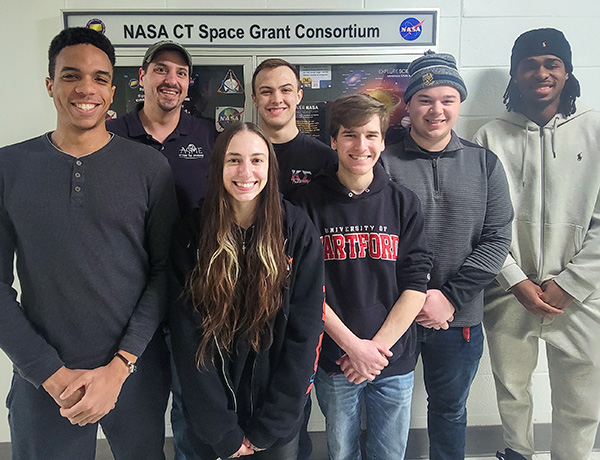
The half-dozen students of the HAWKS NASA RockSat-C Project Group are designing, building, and soon, flying a rocket experiment in collaboration with the NASA Connecticut Space Grant Consortium.
The experiment is a timely one. Right now, the Earth is at the peak of its 11-year solar cycle, which brings an increase in sunspots and other activity. That can cause beautiful auroras, but can also affect radio signals and navigation systems like GPS. HAWKS – not just an expression of UHart pride, but also an acronym for High Altitude Weather Kinetics System – aims to study all these solar effects.
The project is being led by Enrico Obst ‘15, M’16, assistant professor of mechanical engineering. Obst has been involved with student collaborations with NASA since 2017 – most recently the ballooning project in which CETA students monitored atmospheric conditions during the 2024 solar eclipse.
Six students are in the project group, all bringing different levels of experience, knowledge, and skills. Nicholas Krupa ‘27, an electrical engineering major and physics and mathematics minor, says the project has given him an incredible opportunity to lead a multidisciplinary team. “Throughout the project,” he says, “I have applied my engineering knowledge to develop innovative solutions, including designing custom circuits, integrating sensors, and conducting data analysis to meet NASA's rigorous standards. Collaborating with my talented peers has reinforced the importance of teamwork and communication in achieving ambitious goals.”
Team members Jaylen Brown, Michael Robert, Emmi Nunes, Ajani Rose, and Kiden Scruton are aerospace engineering, mechanical engineering, and computer engineering majors.
Rose says the experiment has opened his eyes to a part of aerospace he hadn’t known much about before. “Being a part of RockSat-C has led me to learn a lot about space events, projects, and inner workings of a rocket,” he says. “Throughout this project, I have contributed my experience and knowledge to help develop solutions, aid in research and design, and combine my experience and knowledge with my team members – while also learning from them.”
Nicholas Krupa, Class of 2027I have applied my engineering knowledge to develop innovative solutions, including designing custom circuits, integrating sensors, and conducting data analysis to meet NASA's rigorous standards. Collaborating with my talented peers has reinforced the importance of teamwork and communication in achieving ambitious goals.