A new national campaign called “Choose Water First” aims to change that—and to help launch it, the International Bottled Water Association turned to the Hydration Health Center at the University of Hartford.
The Center’s executive director, Colleen Muñoz, joined a panel discussion at the Great American State Fair on the National Mall in Washington, DC, as part of the America 250 celebrations. Muñoz also lent her expertise to the ongoing social media campaign encouraging Americans to make water their beverage of choice. The campaign also aims to expand access to water in schools and improve public water and recycling infrastructure in communities.
It’s just the latest example of the many ways in which the Hydration Health Center has become a trusted source of information when it comes to water and health. Since its founding in 2022, the Center has become a media go-to for questions about water—such as when the Wall Street Journal and HuffPost asked whether too much water could be as dangerous as too little.
For more than a year, though, the Center has been engaged in a pilot project that has involved the largest clinical trial ever conducted on the UHart campus, examining the potential relationship between hydration practices and aspects of community economic health. “We aim to demonstrate the value of optimized hydration practices by implementing contemporary hydration education and collecting survey data within our local communities,” Muñoz says. “This initiative is designed to support and sustain a healthier population.”
Colleen Muñoz, Director of the Hydration Health Center; Professor of Health SciencesWe aim to demonstrate the value of optimized hydration practices by implementing contemporary hydration education and collecting survey data within our local communities. This initiative is designed to support and sustain a healthier population.
More than a dozen undergraduate students from five programs across two of UHart’s colleges were research assistants on the project. Their activities included completion of a research ethics course, recruiting and interacting with study participants, visit preparation, survey administration, and blood and urine processing and analysis.
“By far the most valuable aspect of being a research assistant was being able to apply concepts and skills that I had only ever theoretically learned about in my classes,” says Alexandra Magrey BS’26, a pre-med student who worked with the Center. “It was incredibly rewarding to finally put some of that knowledge to real-life use.”
Payton Twombley ’27 agrees. “I saw in real time the process of performing participant-based research, from the recruitment of new participants, scheduling the participants and assistants to meet consistently, collecting data, tweaking and correcting procedures as mistakes or oversights occurred, and keeping consistent communication with the research team.”
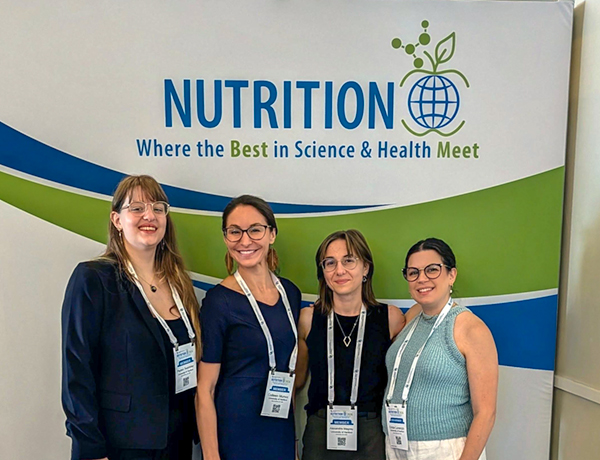
The multidisciplinary project involves collaborations with faculty from the departments of psychology, health sciences, and computing sciences. Magrey and Twombley, along with Muñoz and a research assistant, recently presented four peer-reviewed scientific posters based on the project at the American Society for Nutrition Conference just outside Washington, D.C.
The research has also inspired the Niagara Community Ambassador Network to award the Center a $50,000 grant to significantly expand the research. “This support allows us to expand our work at the intersection of health, well-being, and local economic outcomes,” Muñoz says.
The Center’s mission is necessary, Muñoz says, because water touches every aspect of our health. “Optimizing daily hydration is a simple, cost-effective practice with the potential to significantly enhance individual well-being and, by extension, community health,” she says. “These improvements can also contribute to greater economic stability and development through a healthier, more productive workforce.”