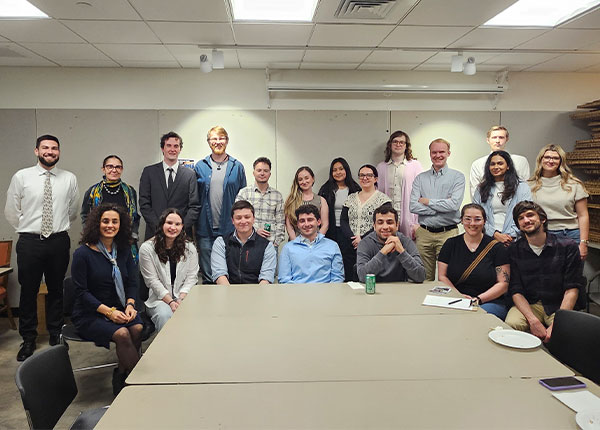
HASA, a student-run graduate organization, supports Hartford-area non-profit organizations by assisting with early-stage design and feasibility studies for meaningful projects. Now, in partnership with Trinity Health and AARP, HASA has been awarded a $5,000 grant for the Hartford Healthy Living 2026 Design Competition.
The grant money will be awarded to students who submit the best entries, as selected by a committee of judges including UHart architecture faculty members Michael Crosbie and Jill Bambury. The prize money will contribute to student tuition and school supplies.
"This project is people-oriented, which I believe is the basis of all architecture," says Megi Lubonja, a second-year Master of Architecture student and president of HASA. “Architecture should be about improving the lives of others."
The competition's purpose is to design communities where families can proudly call home for generations, a goal which resonates with Lubonja. "My focus at this point of my academic journey is precisely what this project aims to do—offering healthy living opportunities for people across different parts of our community."
The project began several months ago when HASA faculty advisor Daniel Horowitz contacted Hartford's former city architect. "I explained that we had a student group interested in volunteering with regional non-profit groups," explains Horowitz, an assistant professor of architecture and director of the graduate architecture program at UHart's College of Engineering, Technology, and Architecture (CETA).
He was then connected with Carolyn Alessi, regional health equity and community impact director for Trinity Health of New England, who informed him about the Healthy Living initiative. Additional funding was needed for the competition, and it was suggested that AARP be approached.
Megi Lubonja, President of the Hartford Architecture Student Association (HASA)When we started our club, the idea of a design competition was just that—an idea. Now we have a significant grant to do what we want to do, and we're thinking of all the next steps. Anything and everything is possible.
"So I wrote a letter of support as the HASA advisor," Horowitz continues. "The grant was ultimately won because of the hard work of the students and the hard work of Carolyn and her team. Basically, I left the grant proposal to the students to handle on their own. And they were incredible! They followed up when they had to, went to all the pertinent meetings, collaborated with all the stakeholders, and turned this idea into a reality."
Aziel Rivera, one of the students involved, is immensely proud of his team’s role in the project. "Our work will play a crucial part in getting the final design funded and approved, as well as giving the eventual developers a guideline as to what to build," says Rivera, a second-year architecture master's student. "My own primary role is with social media, marketing, and public outreach to help get the HASA competition fully underway."
The Hartford Healthy Living 2026 Design Competition is part of an earlier initiative called the Healthy Living Residential Model, anchored by Trinity Health's Saint Francis Hospital. Over $1 million was invested to engage residents in addressing community health challenges, focusing on municipal policies, environmental considerations, and other factors.
"In past years, we have engaged University of Hartford students through shadowing opportunities within our department," notes Alessi. This marks the first time, however, that Trinity Health has partnered directly with a student organization on a community-driven initiative of this kind.
The HASA students at CETA, Alessi says, played an exceedingly important role in preparing the grant application by accurately describing their proposed contributions to the project. "Once the $5,000 grant was awarded, we worked collaboratively with the students and community partners to launch the competition. The students have been instrumental in developing promotional materials, helping with early design concepts, recruiting fellow students to participate, and so much more. Their creativity, leadership, and enthusiasm have been invaluable to this project's eventual success."
Lubonja, HASA's president, says one of the most important lessons she learned is to believe that any idea, regardless of scope, is achievable. "Especially," she emphasizes, "if the right people are passionate enough to bring their ideas to life. When we started our club, the idea of a design competition was just that—an idea. Now we have a significant grant to do what we want to do, and we're thinking of all the next steps. Anything and everything is possible."