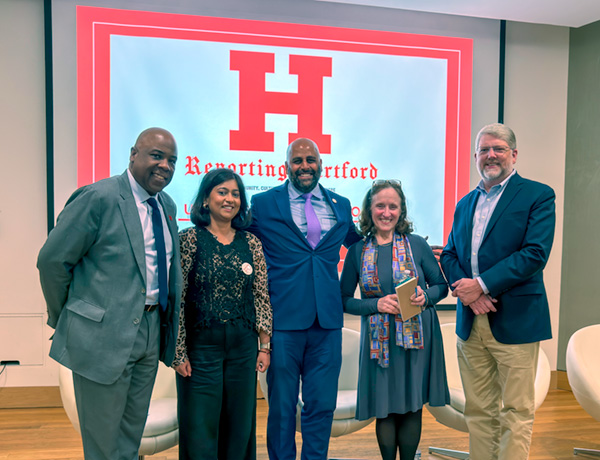
“In the old days, reporters and editors always decided what the news was,” said Helen Bennett, executive editor of the Hartford Courant. “I can remember being a reporter, going to town halls, and going to meetings, and going to schools, and I was the one who figured out what the story was going to be.”
Now, anyone with a cellphone can be a journalist, and traditional newsrooms are a fraction of their former size.
“I’ve talked to folks who’ve been in City Hall long before me,” said Hartford Mayor Arunan Arulampalam, “and in the 1970s and 80s, there were six full-time reporters just from the Hartford Courant stationed in City Hall. There’s not a single one for the city of Hartford now.”
Bennett, the mayor, and Stephen Busemeyer, managing editor of the Connecticut Mirror, participated in a panel discussion in Wilde Auditorium recently entitled “Local Beats, Vital Streets,” exploring the state of local news, and how community journalism might step in to fill the gap. The panel was moderated by Deepa Fadnis, director of UHart’s digital media and journalism program. She asked why some areas, like Hartford, have become news “deserts.”
“I feel like Hartford doesn't get the attention in Connecticut that it deserves,” Bennett said. “It's the capital city, it's where the government of Connecticut lives, it’s a city of extraordinary people, extraordinary events, extraordinary places to go and things to do. And I think—and I’ve been fighting it for five years—that the rest of Connecticut turns a blind eye to that.”
In an era when digital and social media gives editors detailed information about who reads what, much of the panel discussion focused on which stories should be covered—the ones people are actually interested in, or the ones journalists think they should know.
“There's always been a tension in newsrooms about whether we should cover the good news or the bad news,” Busemeyer said. “Lots of people say, ‘We want the good news.’ … But then you have to ask: what is the role of journalism in in a city like Hartford? Is it our job to tell the success stories at the expense of pointing out the problems?”
Fadnis is also the editor of Reporting Hartford, a student-led community digital news publication and newsroom, in which University of Hartford students cover issues that directly affect local residents. Reporting Hartford aims to highlight the kinds of community-level stories not always found in mainstream media.
Lawrence P. Ward, President, University of HartfordThe future of Hartford and the broader region will be shaped not only by the decisions that leaders make, but also by the stories that we tell about ourselves.
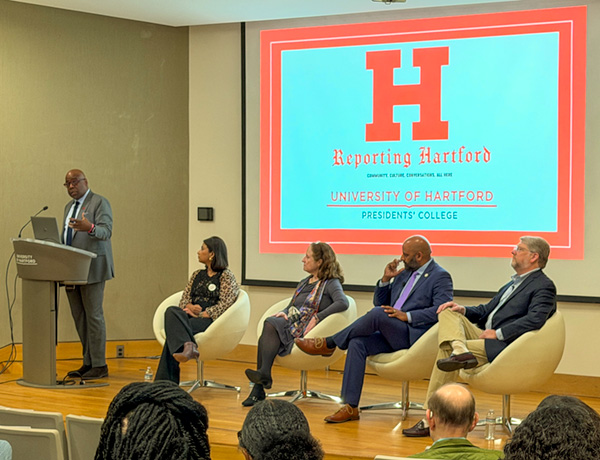
In his keynote remarks at the start of the panel discussion, UHart President Lawrence P. Ward said that journalism—from whatever source—is part of what knits a community together and moves it forward.
“The future of Hartford and the broader region will be shaped not only by the decisions that leaders make, but also by the stories that we tell about ourselves,” Ward said. “If we tell stories that are honest and tell stories that are inclusive, if we tell stories that are authentic and hopeful, yet also grounded in the realities of our communities, we create a foundation for progress.”
For Bennett, the impact of news hits on a personal level as well. She talked about a longtime reader who had often sent in letters sharing his thoughts on the news—but one day, told her he planned to stop. “He told me he’s too old to do this anymore, he’s got to retire. I said, ‘Please don’t. You have thoughts about what’s going on. You have to share them.’”
The day of the panel, Bennett said, she received another letter from him: “He said, ‘Helen, I feel like I’m your brother and you’re my sister now, because you have cared so much about me being able to share my voice.’”