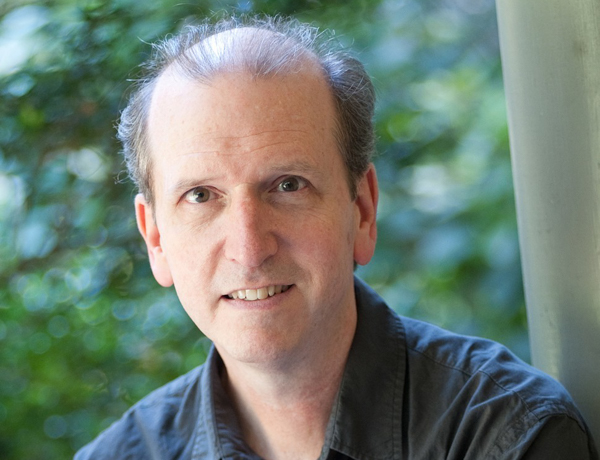
Why frogs? “They’re really fun to draw,” Wiesner told the audience in Wilde Auditorium. “Kind of these round, squishy shapes with bulgy eyes. And then I drew one on a lily pad—this sort of domed shape on this flat circular bottom piece. It looked like a flying saucer. So what if I made it fly like a flying saucer?”
Those flying frogs became the inspiration for Wiesner’s 1991 book, Tuesday, for which he won the Caldecott Medal. The award is presented each year to the illustrator of the most distinguished American picture book for children. Wiesner would go on to win two more—one of only two artists ever to win the coveted award three times.
Wiesner recently delivered the first lecture in the 2026-27 Auerbach Visiting Artist Lecture Series, in which the Hartford Art School (HAS) brings visiting artists to campus each year for one to two days. During that time, the artist delivers a lecture and spends time in the studios critiquing student work.
In his lecture, which was free and open to the public, Wiesner gave a detailed look into his process, from rough pencil sketches through finished paintings—sometimes using items such as plastic models for reference as the illustrations come together.
Wiesner says Tuesday was finished relatively quickly, but Flotsam, for which he won the Caldecott in 2006, took four years. “You would never believe the first version was part of the same book if you saw it,” he said. “It just becomes a process of drawing and redrawing and redrawing and trying things and discarding some things. But every failed attempt leads me somewhere farther down the road.”
Wiesner also took questions from HAS students in the audience, telling them about his earliest experiences as an illustrator. “When I came out of school, I would do any job anybody paid me to do,” he said. “I was doing early readers. I did book jackets. I did textbooks. It was a place to learn how to be a professional illustrator. It forced me to draw stuff I’d never drawn.”
One student asked how to get started on a picture book idea, even one not fully formed. Wiesner’s advice? Don’t worry about developing it in a linear fashion. “Don’t get stuck on page one,” he said. “Go to page 28. Start in the middle. Find the parts you like. See where they feel like they fit in the story and then build stuff around it. I’ll bet you’ll find out an awful lot about the structure of it and what you might want to say.”
The Auerbach Visiting Artist Lecture Series began in November 2001 and is made possible by a gift from the Beatrice Fox Auerbach Foundation Fund of the Hartford Art School Endowment, Inc.