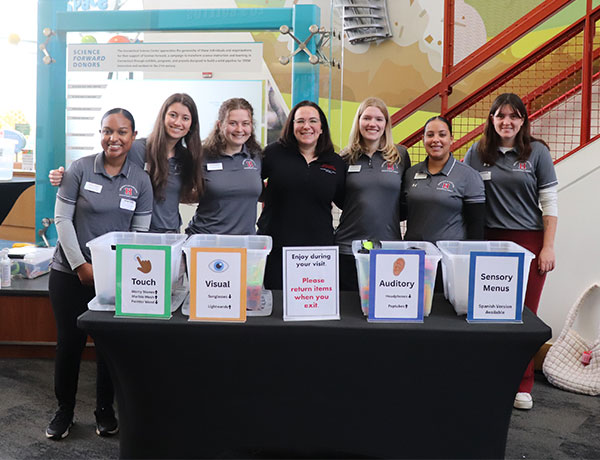
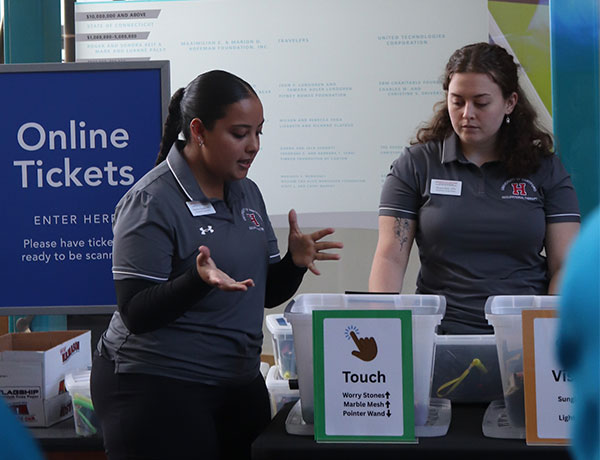
Located in Hartford, the Center sets aside certain days throughout the year to provide a calmer experience—by turning down the sound levels in exhibits, for example. But the Center wanted to strengthen its Sensory Friendly Days with evidence-based strategies and practical tools, so it called on some students in the University of Hartford’s Master of Science in Occupational Therapy (MSOT) program.
In the months leading up to the first revamped Sensory Friendly Day, the students conducted a formal needs assessment and a comprehensive review of current research. They used that data to develop practical resources, such as a pocket-sized “sensory menu” highlighting the sensory experiences visitors might encounter in each exhibit space. The students also supplied evidence-based sensory fidgets so that visitors could engage with exhibits in ways that worked for them.
The students were able to see the impact of their work firsthand in early November, when the first enhanced sensory day was held for the public at the Connecticut Science Center. Bethany Seeley ’27, one of the students who worked on the project says the skills she and her team learned in the MSOT program equipped them to do their jobs effectively.
“The content covered during our pediatrics semester, particularly regarding autism, sensory processing differences, and the implementation of universal design, has helped our team identify ways to modify and accommodate guests' experiences throughout the exhibits to make them more accessible and inclusive,” she says. “Additionally, our leadership and professionalism courses have prepared us for the various meetings with Connecticut Science Center staff, the development and presentation of proposals, and the communication and collaboration required to bring this project to life.”
Eva Cintron, the Center’s director of visitor experience, says the collaboration with UHart—which builds on a longstanding partnership between the two institutions—was a big success. “Through our collaboration with the University of Hartford team, we gained fresh perspectives, valuable insights, and innovative ideas to help us build on and further strengthen our existing Sensory Friendly Days program,” Cintron said.
UHart’s MSOT program director, Sarah Psillas shares her excitement about the successful initiative.
“Many organizations are committed to creating more inclusive experiences but may not have specialized training or the resources to know where to begin,” says Sarah Psillas, UHart’s MSOT program director. “This partnership allowed our occupational therapy faculty and students to bridge that gap by applying their expertise to help make the Connecticut Science Center more accessible and welcoming for individuals with diverse sensory needs.”
For Seeley and the student team, it was a unique opportunity to take their knowledge outside the classroom.
“It has been especially rewarding to see how relatively simple adaptations, such as visual supports and sensory considerations, can create more accessible, engaging, and meaningful experiences for individuals with diverse needs,” Seeley says. “This project has reinforced my appreciation for the role of occupational therapy beyond traditional clinical settings and the impact we can have within our communities.”
Sarah Psillas, MSOT Program DirectorThis partnership allowed our occupational therapy faculty and students to bridge that gap by applying their expertise to help make the Connecticut Science Center more accessible and welcoming for individuals with diverse sensory needs.