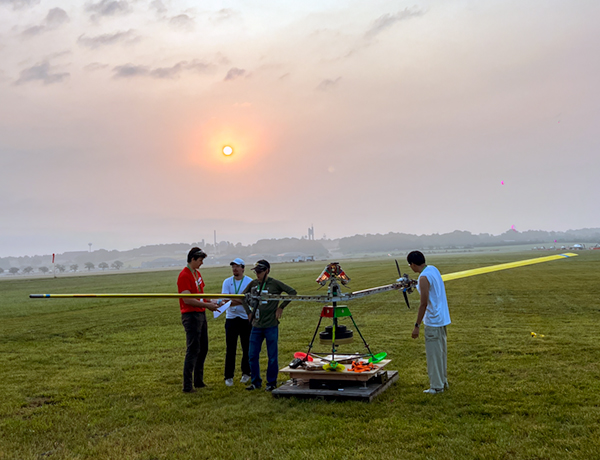
Working alongside Piasecki Aircraft Corporation and the FNP Foundation, the students put their engineering knowledge to the test, ultimately demonstrating that their aircraft could successfully lift and fly with payloads of 55 and 110 pounds.
Led by Professor Dongbin Kim, the team advanced through several stages of a highly competitive process. Of the 489 teams that initially applied, 225 cleared the technical benchmarks, 132 were invited to participate, 76 checked in at the competition, and just 62 passed the required safety checks. The UHart team successfully navigated each stage, earning the opportunity to bring its aircraft to the flight line.
Although the team did not receive an official scored flight after the aircraft did not pass the no-payload check flight on two attempts, its successful payload check flights demonstrated the capabilities of an unconventional aircraft design.
"I'm incredibly proud of our students from the University of Hartford," Kim shared. "They kept building, testing, failing, fixing, and pushing forward through every setback over summer."
From the Classroom to the Real World
For the students involved, the challenge offered an opportunity to move beyond classroom exercises and contribute to the development of an actual aerospace system. As research interns at the Hartford University Systems Lab (HUSL), students took on responsibilities spanning computer-aided design, materials selection, composite fabrication, aircraft construction, and testing infrastructure.
Taeyong Eom ‘28 focused on 3D CAD design, composite 3D printing, and test infrastructure. Working closely with Piasecki Aircraft, he designed structural components using the CAD software SOLIDWORKS, including rotor blade endcaps, air brakes, and sensor mounts. He also optimized 3D printing settings to fabricate components using high-strength carbon fiber composites.
One of his most technically demanding responsibilities involved fabricating composite rotor blades using carbon fiber, laser-cut wood, 3D-printed components, and Mylar film. Because the blades operated at thousands of revolutions per minute, even a small imbalance could create significant vibration. Eom maintained exceptionally tight manufacturing tolerances, keeping the weight of individual internal ribs within ±0.01 grams to help ensure proper rotational balance.
Daniel Szarwacki ‘28 contributed to the physical construction of the aircraft and developed tools to collect critical performance data. He also designed two important testing systems. The first was an engine test beam, which allowed the team to mount and test the engines separately while simulating their operation on the aircraft. The second was a load cell plate installed beneath the drone to measure its lifting capability as additional weight was introduced.
Developing the engine test beam required multiple revisions throughout the summer as the aircraft's design evolved. Szarwacki had to account for individual components, including fuel tanks, engines, and engine mounts, while ensuring that the test setup accurately represented the full aircraft.
His contributions drew directly on skills developed in the classroom. An introduction to SOLIDWORKS helped him design components such as an encoder, while coursework in flight mechanics gave him a stronger understanding of the aerodynamics and physics behind the aircraft's operation.
Overcoming Setbacks Through Testing and Collaboration
Building an experimental aircraft comes with challenges, and the team encountered several throughout the development and competition process.
One significant setback occurred when the aircraft experienced a crash during early testing, damaging its wings and several 3D-printed components. Later, during the main DARPA event, the primary rotor blades were severely damaged during a flight test.
But the students pressed on, working together to rebuild and improve the aircraft. Eom recalled that the team stayed up throughout the night reprinting components and manually rebuilding the blade assembly to prepare the drone for another flight.
The experience reinforced the importance of designing for real-world conditions, which can differ considerably from computer simulations and initial design models. For Eom, the setbacks shifted his approach toward a more hands-on, data-driven engineering process. He began placing greater emphasis on ground-test results and using those findings to discuss potential improvements with the team's chief technology officer and researchers. He also learned to incorporate safety equipment and risk mitigation into the design process from the beginning.
Szarwacki similarly learned the importance of thoroughly evaluating every aspect of a design. Following the initial crash, he became more intentional about checking both the aircraft's physical structures and its electronic systems before moving forward with testing.
Both students emphasized the importance of collaboration and persistence in working through unexpected problems. The experience demonstrated that engineering is not simply about developing a design that works on paper; it requires the ability to adapt, troubleshoot, and continuously improve when real-world conditions present new challenges.
Dongbin Kim, Electrical and Computer Engineering ProfessorThey kept building, testing, failing, fixing, and pushing forward through every setback over summer.
Preparing the Next Generation of Engineers
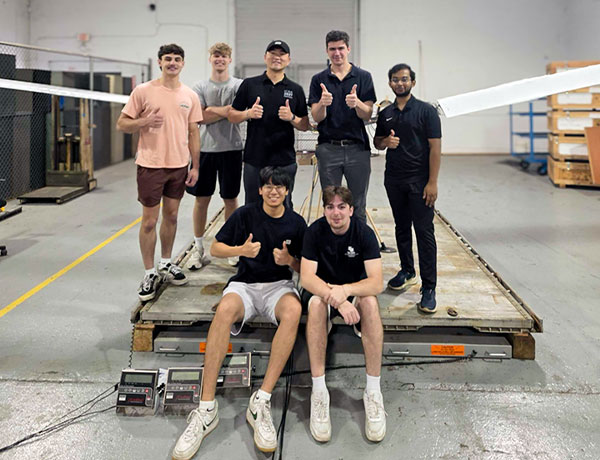
Beyond the technical accomplishments, the DARPA Lift Challenge provided students with valuable experience working alongside industry professionals and contributing to a complex engineering project from its earliest stages through competition.
Eom's proudest accomplishment was using his CAD designs and test data to lead technical discussions with the team's CTO and international collaborators. Earning their trust as a core member of the engineering team, he said, was particularly meaningful, especially while navigating language barriers.
The experience strengthened his interest in pursuing a career as a global mechanical and robotics engineer, with a focus on advanced mobility and aerospace systems. For Szarwacki, seeing the engine test beam he designed and assembled become an integral part of the testing process was a particularly rewarding moment. He says the project reinforced his interest in pursuing a career in engineering, particularly in drone design and development.
Professor Kim also recognized the contributions of Piasecki Aircraft Corporation and the FNP Foundation, crediting their advice, leadership, and guidance throughout the challenge.
While the team did not receive an official competition score, successfully demonstrating the aircraft's ability to lift and fly with a 110-pound payload represented a significant milestone. The experience gave UHart students the opportunity to tackle a complex aerospace engineering challenge, contribute meaningful technical solutions, and experience firsthand the persistence and collaboration required to turn an ambitious concept into a functioning aircraft.
As Kim looks toward the next generation of drones, the lessons learned throughout the competition will carry forward—along with the experience gained by the students who helped make the project possible.