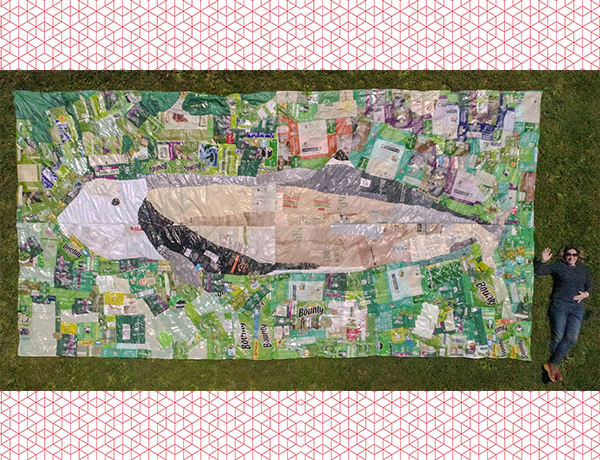
For University of Hartford Professor Katharine Owens, that question is at the heart of Entangled and Ingested, an ongoing art project that transforms discarded plastic packaging into vivid, life-size portraits of marine animals harmed by pollution.
Drawing on her expertise in environmental science and policy, Owens, director of UHart’s environmental studies program and the politics, economics, and international studies department chair, combines art, research and community collaboration to make the consequences of single-use plastics impossible to ignore. From sewing whales with students to bringing scientists and schoolchildren together in collaborative workshops, she hopes to inspire people to rethink everyday choices, engage with policymakers and see how creativity can help turn environmental awareness into meaningful change.
“I’m hoping that people will make that connection between these materials and the animals that are harmed by the materials we use, and that they would contact policymakers at every level and ask them to create real comprehensive policy that reduces the amount of single-use plastics in our world,” she says.
Owens started making the portraits in 2020 during the pandemic when her international research was canceled. Since then, she’s made more than 70 individual portraits out of recognizable items like food packaging. She says she sees her artwork as a way to bridge the gap between scientific knowledge and emotional understanding.
“That’s one of the reasons I chose to create life-size portraits of the animals,” she says. “I’m very much a visual learner and I think when you see the actual size of a group of 70 animals, and you realize how many different kinds of species are being affected by this huge problem that it makes a big impact.” She hopes to one day see all the pieces displayed together in one venue, creating a powerful visual statement about the impact of plastic pollution.
Kat Owens, Professor; Department Chair of Politics, Economics, and International StudiesI think the arts have a special power. They can connect with people in a way that another data point or another statistic or another scientific article cannot. Art makes an impression on us that lasts a long time. Art is a powerful way to share ideas and to help people understand problems more deeply.
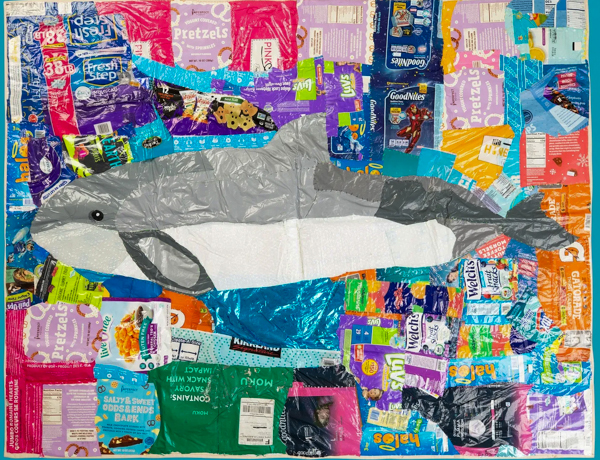
This year Owens has taken her message, and artwork, to Alaska. “I was specifically looking for outlets that had both a strong science component and a strong art component. The Pratt Museum in Homer, Alaska, is one of those venues. I’m sometimes a little too arty for science venues and a little too science-y for art venues, so I wanted to find an institution that I felt celebrated both.”
For that show, she selected pieces from the Entangled and Ingested series that were local to that region. “I have signage that accompanies the exhibition that briefly describe the problem of plastic pollution, how these animals are harmed, and what a regular person like you and me can do to move the needle on this big global problem,” she says.
This fall, Owens also traveled to Cádiz, Spain, for MICRO, an international research conference on plastic pollution. There she presented her research and collaborated with Natura Sin Basura (Nature Zero Waste), a local nonprofit that brought approximately 200 Spanish schoolchildren to the event. “I had the opportunity to sew with many of the students, as well as roughly a quarter of the 800 scientists attending the conference, to create an 80-foot-long fin whale, which is the biggest whale on my list of species with records of both entanglement and ingestion through pollution.”
Over the years, hundreds of UHart students have participated in Owens’s whale-sewing workshops through her classes and campus-wide programs. Harrison Grant recipients and Dorothy Goodwin Scholars have also joined Owens in the community, working alongside residents of nursing homes and local schoolchildren to sew a whale together.
While helping students understand the severity of environmental challenges is essential, Owens recognizes that the weight of these issues can leave them feeling overwhelmed and hopeless. She sees artmaking, particularly sewing, as a way to restore hope and empower students to engage with these challenges in a more positive, creative way.
“Sewing is a very meditative and relaxing practice,” she says. “When I bring a whale to my classes, my students report that they feel much better about things after having spent an hour sewing a whale.” She says it also offers students a tangible example of interdisciplinary work, demonstrating how science, art and environmental policy can intersect to address complex challenges.
“I think the arts have a special power,” she says. “They can connect with people in a way that another data point or another statistic or another scientific article cannot. Art makes an impression on us that lasts a long time. Art is a powerful way to share ideas and to help people understand problems more deeply.”