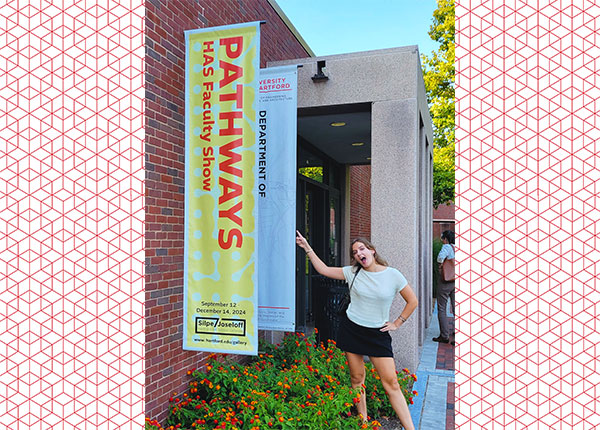
For recent Hartford Art School alumna Marina Bak ’26, internships were more than opportunities to gain professional experience.
They became an essential part of her education at the University of Hartford, helping her discover how her interests in graphic design, art history, museums, publishing, and community could intersect.
As a Visual Communications Design and Art History double major, Marina sought experiences that would allow her to apply what she was learning in the classroom to real-world creative projects. Across three very different internships—from designing an artist publication with faculty member Power Boothe, to immersing herself in an artist collective in Serbia, to creating the visual identity for the Hartford Art School’s faculty exhibition Pathways—Marina developed not only her design practice, but also her understanding of collaboration, communication, and the role artists and designers can play in building community.
Collaboration with Faculty
One of Marina’s internships gave her the opportunity to work directly with Professor Power Boothe on the design of a publication featuring his drawings.
The experience brought together several of her academic and professional interests: art history, publication design, and her aspirations to work in museums and design. Rather than simply creating a piece of graphic design, Marina was able to learn about an artist’s career and consider how his work, materials, and artistic practice could be translated into a publication that would reach major art venues and collectors.
“This internship allowed me to work directly with Professor Power Boothe to design a publication of his drawings,” Marina explained. “I was intrigued to learn about Power’s art career to translate into the best suited design for this project.”
The experience gave Marina a firsthand understanding of the publishing process and the many decisions involved in designing for an artist. It also demonstrated how her two majors could complement one another: her knowledge of art history could inform her visual and editorial decisions, while her design skills could help bring an artist’s work to a broader audience.
Learning Through Community in Serbia
Marina’s internship experiences extended far beyond the University of Hartford. At Cetri Vode Art Collective in Užice, Serbia, what began as an internship or shadowing opportunity quickly evolved into an immersive experience in community, collaboration, and cultural exchange.
Working alongside people from Serbia, Romania, Greece, and Turkey, Marina participated in workshops, screenings, discussions, creative projects, and the physical work of maintaining and expanding the collective’s space. She helped renovate an old cottage into a library by building furniture, worked on the stone-tiled porches of the cabins, and helped move tools and supplies as the collective prepared to transform a garage into a future studio and residency space.
But some of her most meaningful learning came through conversation.
Marina pushed herself to participate in difficult discussions and explored how artists can create spaces where challenging ideas become opportunities for dialogue and shared knowledge. Through the collective’s workshops, she learned about communication, care, and the ongoing work required to sustain a creative community.
“Just in general my time at Cetri Vode felt like a lesson on how to communicate, exchange, and care for each other and our needs collectively,” she reflected.
The experience also connected Marina more deeply with her Serbian heritage. Immersed in the city, she practiced speaking Serbian, learned recipes that now make her feel at home, and discovered a stronger connection to her cultural background.
Perhaps most importantly, Cetri Vode challenged Marina to think differently about what an internship could be. Rather than simply observing professional artists, she became an active participant—contributing her labor, sharing ideas, listening, and learning how a collective operates.
She returned to Hartford with questions and lessons she hoped to bring into conversations at the Hartford Art School: How do we communicate as a collective? How do we make room for different perspectives? How can difficult conversations become shared knowledge?
Marina Bak ’26, Hartford Art School AlumnaJust in general my time at Cetri Vode felt like a lesson on how to communicate, exchange, and care for each other and our needs collectively.
Combining Design and Art History
Back at the Hartford Art School, Marina had another opportunity to combine her two majors through an internship supporting the organization of the faculty exhibition Pathways.
As one of eight art history students who contributed to organizing the exhibition, Marina served as its graphic designer. Once the exhibition title was established, she developed a visual identity built around bold typography, punchy colors, and playful arrow motifs—a design language intended to capture the energy and joy of the community that gathers at the Hartford Art School Galleries.
Working throughout the summer, Marina created designs across the exhibition experience, including the title wall, object labels, interactive “Impressions” wall, magazine advertisements, posters, campus monitor graphics, and a striking 24-foot-long banner displayed in West Hartford Town Center during the week of the exhibition’s opening.
The project gave Marina an opportunity to move from classroom exercises to a public-facing design project with a real audience and tangible impact. She was not simply designing individual pieces; she was creating a cohesive visual experience that helped communicate the identity and spirit of the exhibition.
“This internship allowed me to combine my two majors in graphic design and art history,” Marina said. “I focused on creating an experience for the audience that expresses the close relationship we have with our faculty.”
That focus on audience and community became a defining thread throughout her internship experiences.
An Education Beyond the Classroom
Marina’s internships illustrate the power of experiential learning at Hartford Art School. Each experience challenged her in a different way.
Working with Power Boothe introduced her to professional publication design and the process of translating an artist’s practice into a finished object. Her time at Cetri Vode expanded her understanding of collaboration, cultural exchange, and what it means to contribute to a creative community. And designing Pathways gave her the opportunity to bring her academic disciplines together in a highly visible project for the Hartford Art School and the broader community.
Across her internships, Marina learned that design is about more than aesthetics. It is about communication, storytelling, audience, collaboration, and connection.
Her internships also helped clarify the possibilities available to her as a designer and art historian. Whether working with an individual artist, an international collective, or an academic gallery, Marina learned to approach each project with curiosity and an understanding of the people and stories behind it. Her experiences alongside her Hartford Art School education gave her opportunities to contribute—to create work that would be seen, used, discussed, and shared beyond the classroom.
About the Hartford Art School Endowment, Inc. Internship Fund
Thanks to the generosity of Hartford Art School Endowment, Inc. donors, the Hartford Art School provides scholarships for students to pursue internships through its Internship Fund (formerly the C3 Internship Fund). This fund is intended to help undergraduate students participate in valuable internships or artist residency experiences that have great potential but may not be “affordable” for all students. It is a competitive program for those pursuing a high-quality practicum that is likely to further their academic goals, professional goals, and career exploration. Since 2020, the fund has provided over 69 internship and residency awards, over $180,000 invested in student experiences, and forged relationships with professional artists, museums, galleries, design firms, and creative organizations.