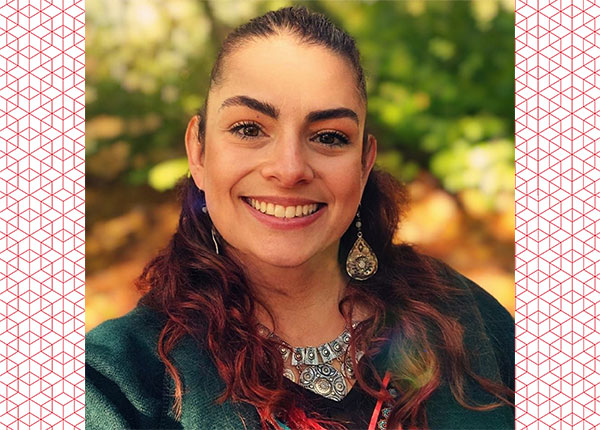
Bevin Rainwater, an Indigenous American descended from the Cherokee and Choctaw nations, was not raised in or near her tribal homelands. “As an Indigenous person who has had to navigate predominantly non-Indigenous spaces for most of my life, it made me feel like I had to earn or prove my identity,” Rainwater says about her years growing up in the Southwestern United States, where she looked nothing like the tribal members of the area. “As a diasporic Indigenous person, distanced from native soil and communities, that's what shaped much of how I used to understand identity, belonging, and what I call survivance.”
If there is a longing detectable in her memories and sentiments of the past, it's understandable. But today it's a different story, because through her work as a professional educator, cultural researcher, and activist, she has taken many giant leaps toward fully understanding and appreciating her identity. She has developed a clear sense of belonging and has survived exceedingly well.
Between her personal mission, her roles at the University of Hartford as staff member in academic technology, an adjunct instructor of Native American cultures, Spanish, computer science, and other subjects, and her work with the campus-based group Amplifying Indigenous Voices, Rainwater has arguably become one of the strongest, most confident, and passionate voices of her Indigenous world.
“I've experienced a genuine cultural reawakening, and it's been building for about 20 years, with a real deepening in all the time I've been at UHart,” says Rainwater, who joined the staff in 2015. “Part of what makes this place meaningful to me [Connecticut] is that it's an environment where Indigenous peoples and tribal nations are respected without the reflexive racism I encountered in other contexts growing up. That's not a small thing.”
Her Indigenous historical roots trace back to Tennessee and Mississippi, from which her family was forcibly removed via the Trail of Tears to Oklahoma. (In addition to Cherokee and Choctaw, she also has English and Irish ancestry.) Her grandparents left Oklahoma and moved to Los Angeles during what is often regarded as the Indigenous urban relocation era of the 1930s.
“Growing up, my immersion into my Indigenous heritage was real, if not always formal,” she explains. “I attended powwows, visited and had relationships with tribal members on reservations across the Southwest, and occasionally visited family on the Cherokee reservation in Oklahoma. My mother was a Cherokee speaker and our family's last medicine woman, and what she and her father passed down to me—including stories, language, values, a sense of interconnectedness with the land and with each other—came directly from that lineage. But I also carried the grief of the Indigenous diaspora.”
Once she arrived at UHart, her world, already immersed in Indigenous explorations and soul-searching, became even more engaged with meaningful and consequential courses she designed and taught, conversations she had, and continued exploration into her Indigenous world. Her Native American cultures course, for example, is entirely built around a few core commitments. “From the very first class, I push back hard on the monolithic 'Native American' category, and that's because we have hundreds of distinct nations, languages, and relationships to land. We also have sovereignty. A huge part of what I try to do is help students understand that incredible diversity.”
Bevin Rainwater, Staff member and adjunct professor, University of HartfordIn addition to my teaching, the Amplifying Indigenous Voices Affinity Network brings me into a richer relationship with my identity than I had access to in my youth. It's one of the most meaningful things happening in my life.
Survivance, the term Rainwater uses often, was coined by a prolific Indigenous author, literary critic, and educator named Gerald Vizenor to differentiate it from mere survival. It has much to do with the fact that Indigenous people in the present must carry their cultures across the distances created by the diaspora. “Some of the class units I'm most proud of cover missing and murdered Indigenous women, land and water rights, economic disparities, and media representation, including how AI is now generating fake Indigenous imagery and extracting cultural identity for profit without community consent,” Rainwater explains. She shares this all with her students using everything from TikTok and guest lecturers to interactive assignments and live performances. “I ask my students to engage critically, not just to consume information. I've been teaching this course for three years now and I'm still learning from it myself. That's one of the things I tell my students—that intellectual humility is a value our knowledge systems have always practiced.”
Some of her students navigate their own identities from geographic and cultural perspectives. “They try to hold onto who they are inside institutions that rarely see them the way they are,” she says. “When I was working on my dissertation, I was studying experiences that mirrored my own. My advisor, a Jamaican woman with Taino ancestry, actively encouraged me to lean into my indigeneity throughout the process rather than bracket it in the name of objectivity. That was transformative. The dissertation deliberately departs from Eurocentric academic conventions: it opens with Cherokee and English blessings, centers storytelling as methodology, and treats my own positionality as foundational rather than incidental. Writing it was as much a cultural reclamation as it was an academic project.” Rainwater received her doctorate in Educational Leadership for Social Justice from the University of Hartford in May 2026.
The Amplifying Indigenous Voices Group that Rainwater co-founded and continues to work with was formed at UHart with guidance from the Golden Hill Paugussett tribe, which is native to Connecticut. It is comprised of faculty, staff, alumni, community members, and students, who are both Indigenous and non-Indigenous allies, who share a sense of identity, interest, or experiences. The group meets monthly on Teams to plan events and programs, such as trips to participate in powwows regionally, Indigenous events on campus, book readings, and talks by notable speakers.
“In addition to my teaching, the Amplifying Indigenous Voices Affinity Network brings me into a richer relationship with my identity than I had access to in my youth,” Rainwater adds. “It's one of the most meaningful things happening in my life. I share that credit with my co-chair, Judy Wyman, who is a non-Indigenous ally whose sister-in-law is Indigenous. She saw the need on our campus and encouraged me to help found our group.” Recent activities have included events tied to Indigenous Peoples' Day, cultural programming, and involvement with the America 250 planning committee in West Hartford in recognition of the 250th anniversary of the Declaration of Independence. “We are making sure Indigenous perspectives and the ongoing impact of colonialism are part of how we mark that national milestone. We also planted an Indigenous garden on campus this past year, which felt quietly significant.” For her work she received the MLK Beloved Community Award in 2024, along with Wyman, who is Associate Director and faculty liaison for University Interdisciplinary Studies.
Indigenous knowledge systems, notes Rainwater, are fundamentally relational and holistic; centered on community, reciprocity, and accountability. She says she tries to focus on that notion in everything she does academically, including her work as Assistant Director of Academic Technology & Digital Innovation at the University of Hartford. “At the core of my daily work is a commitment to equity and equitable access to education for all students. That shows up in how I support the faculty. The frameworks I share with them, the professional development I design, the way I encourage Universal Design for Learning as a baseline practice rather than an accommodation afterthought—that's all part of my mission.”
Rainwater wants people to understand that there are many ways in which Indigenous people in the diaspora feel they can decisively validate their identity. “We're not just surviving the distance. We're carrying our cultures forward, adapting them, insisting on their presence. That's what I try to model for my students, Indigenous and non-Indigenous alike. This is my professional work. The accessibility initiatives, the course designs, the faculty development, the Affinity network, the dissertation—they are all expressions of the same commitment: making space for people who have historically been made to feel they may not belong. Because we do belong.”