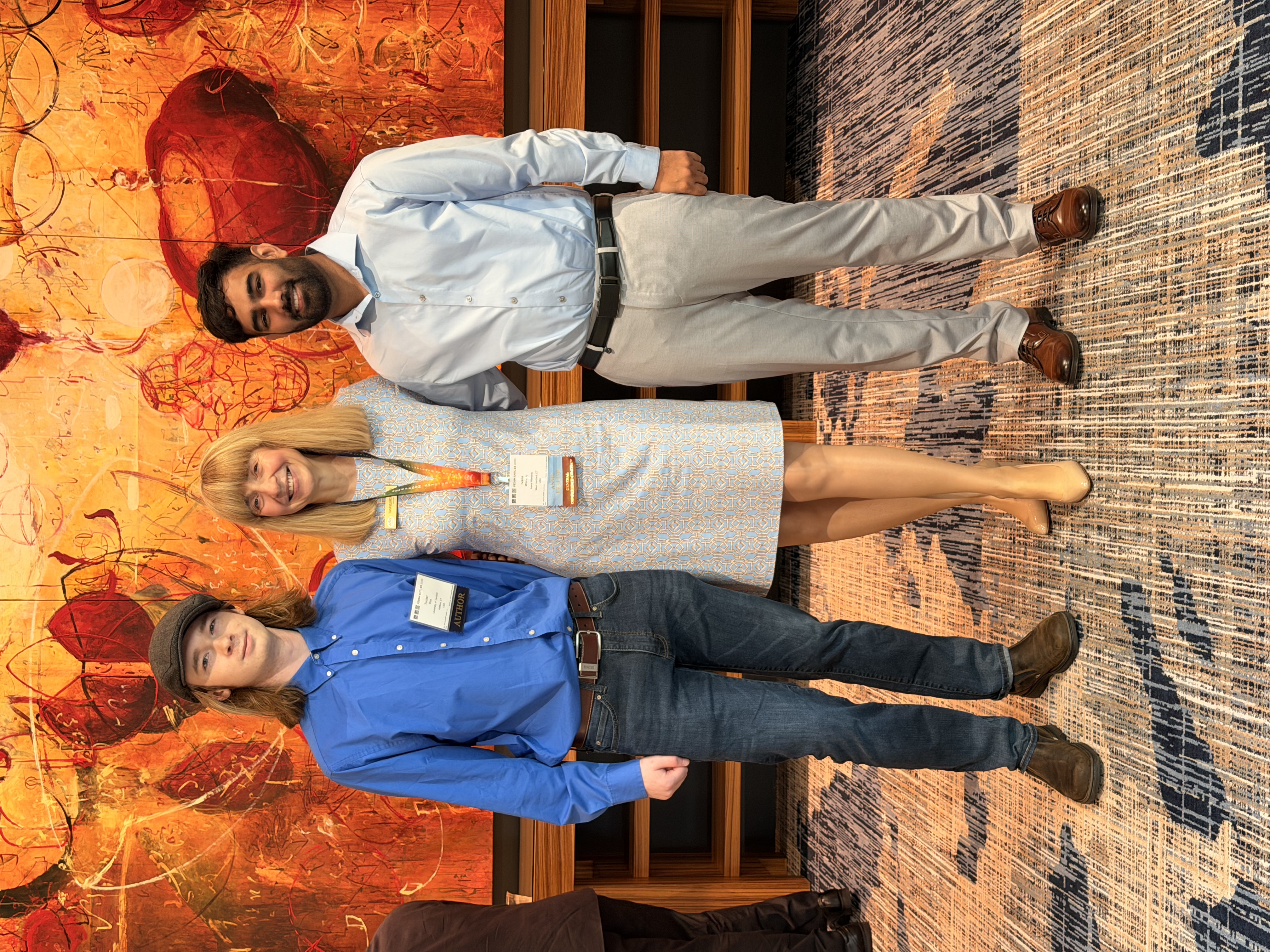
Professor Ivana Milanovic made wide-ranging contributions to the 2026 ASME Fluids Engineering Division Summer Meeting (FEDSM 2026), held July 26–29 in Bellevue, Washington, serving as Conference Co-Chair, researcher, educator, and leader within the international fluids engineering community.
The meeting celebrated the 100th anniversary of the ASME Fluids Engineering Division (FED), bringing together researchers from around the world to reflect on the field's history while exploring emerging directions in fluid mechanics, computational engineering, artificial intelligence, and engineering education.
Professor Milanovic co-authored four peer-reviewed conference papers spanning engineering education, aerospace engineering, computational fluid dynamics (CFD), turbomachinery, and machine learning.
One of the featured presentations, ‘A Century of Fluids Engineering Education: Tradition, Transformation, and Turbulence in an Age of AI,’ co-authored with Professor Philipp Epple (Coburg University of Applied Sciences and Arts, Bavaria, Germany), examined how a century of educational innovation, from boundary-layer theory and experimental visualization to computational simulation and artificial intelligence, has continually expanded engineers' ability to visualize and understand invisible flow phenomena while redefining how future engineers learn.
Additional research contributions included:
‘Direct Machine-Learning Prediction of Radial Fan Performance Maps,’ co-authored with Professor Philipp Epple and Manuel Fritsche, demonstrated how machine-learning techniques can accurately predict complete fan performance maps, enabling rapid design exploration while significantly reducing computational time.
‘Accuracy and Comprehensive Analysis of Richardson Extrapolation for Multiple Flow Quantities in CFD,’ co-authored with Professor Epple, Manuel Fritsche, and recent graduate Tucker Rice, investigated methods for quantifying numerical uncertainty in CFD simulations and provided practical guidance for improving the reliability of computational engineering analyses.
‘Evolution of Leading-Edge Vortices Over a 75° Sweptback Delta Wing in Subsonic and Supersonic Flow,’ co-authored with recent graduates Jagbir Singh Shergill and Tucker Rice and Dr. Frank Y. Wang of the Volpe National Transportation Systems Center, U.S. Department of Transportation, combined high-fidelity computational simulations with experimental measurements to investigate vortex evolution over highly swept delta wings in subsonic and supersonic flight, highlighting collaborative faculty-student research in aerospace engineering.
Beyond her research contributions, Professor Milanovic co-organized the conference's Advances in Fluids Engineering Education technical program with Professor Ray Taghavi (University of Kansas) and Professor Isaac Bernabe Perez Raya (Rochester Institute of Technology). The forum brought together educators to exchange innovative approaches to teaching fluid mechanics through laboratory instruction, computational simulations, experiential learning, curriculum development, and emerging educational technologies.
Professor Milanovic also co-organized the conference's Flow Visualization Competition with Professor Epple. Their team's contribution, ‘Flow Visualization of the Transition from Radial to Squirrel Cage Fans,’ showcased advanced visualization techniques for revealing complex internal flow structures. Because Professors Milanovic and Epple served as competition organizers and judges, their entry was presented but was not eligible for awards.
As Conference Co-Chair, Professor Milanovic helped guide the planning and execution of the division's centennial meeting, working with colleagues to develop the technical program and coordinate one of the Fluids Engineering Division's most significant conferences.
FEDSM 2026 also marked the conclusion of Professor Milanovic's term as Secretary of the FED Executive Committee and the beginning of her service as Executive Committee Vice-Chair. In this new leadership role, she will continue helping guide the division's technical programs, professional activities, and future directions.
Professor Milanovic’s contributions to the division's centennial meeting illustrate how research, education, conference leadership, and professional service together advance the discipline of fluids engineering while preparing the next generation to shape its future.