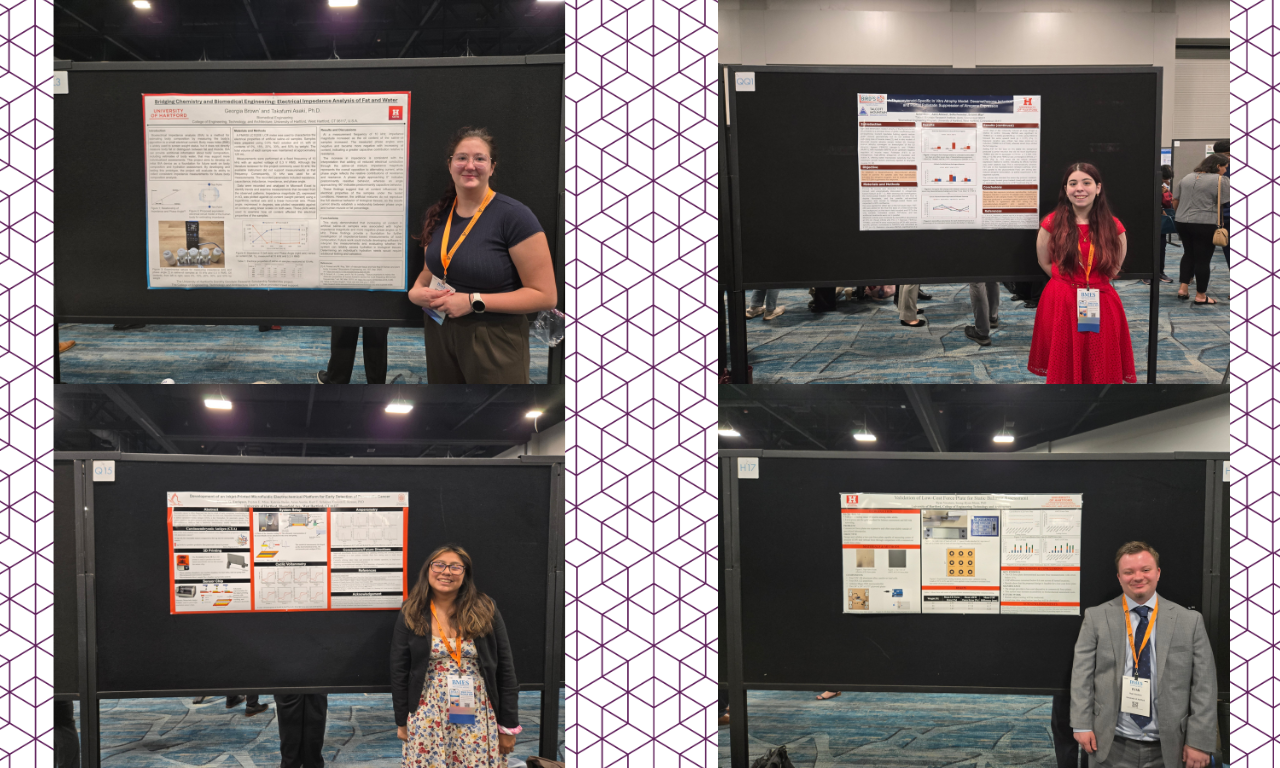
Four undergraduate students from the University of Hartford’s College of Engineering, Technology, and Architecture (CETA): Georgia Brown, Jasmin Enriquez, Sofia P. Ferreira, and Ryan Vocaturo presented research at the Biomedical Engineering Society (BMES) Annual Meeting, held Oct. 21–24, 2026, in Orlando, Florida.
Their projects highlighted the application of engineering and biomedical science to human health. The conference provided an opportunity for students to share their findings, practice scientific communication, and engage with researchers and students from across the country.
Bridging Chemistry and Biomedical Engineering: Electrical Impedance Analysis of Fat and Water by Georgia Brown
Georgia’s project explored bioelectrical impedance analysis (BIA), which uses the body’s response to an electrical signal to estimate body composition, as an alternative to body mass index (BMI). Using vegetable oil and saline solution to represent fat and muscle, respectively, she measured impedance, phase angle, resistance, and capacitance across samples with different oil proportions. Higher oil content was associated with higher impedance and phase angles closer to −90 degrees, supporting the potential of electrical measurements to distinguish differences in the composition of these model samples.
Superior FRET-Based Biosensor to Detect Tensile Force in Talin and Development of an Inkjet-Printed Microfluidic Electrochemical Platform for Early Detection of Pancreatic Cancer by Jasmin Enriquez
Jasmin presented two posters addressing cellular mechanics and cancer detection. Her UCHC project examined talin, a protein that helps cells sense the forces they exert on their surroundings. The team tested several fluorescent “molecular ruler” designs that change their light signals when stretched and identified one that best distinguished relaxed from stretched talin inside cells. This early work supports the development of a tool to measure forces within living cells and study diseases linked to cell mechanics.
Her UHart project focused on developing a low-cost, disposable point-of-care biosensor to support earlier detection of pancreatic cancer, which often causes no symptoms in its early stages. The platform combines inkjet-printed gold sensor chips with eight electrodes and a 3D-printed housing that channels small fluid samples over the sensors. It uses an antibody-based sandwich immunoassay to detect carcinoembryonic antigen (CEA), a cancer-associated biomarker.
A Thyroarytenoid-Specific In Vitro Atrophy Model: Dexamethasone Induction and Partial Follistatin Suppression of Atrogene Expression by Sofia P. Ferreira
Sofia’s research focused on the thyroarytenoid muscle, a muscle within the vocal folds that helps control voice production. Using muscle precursor cells isolated from porcine tissue, the project investigated whether dexamethasone could induce muscle atrophy and whether follistatin could help counteract this process. This work contributes to the development of a laboratory model for studying vocal fold muscle loss and potential approaches to reducing it.
Validation of Low-Cost Force Plate for Static Balance Assessment by Ryan Vocaturo
Force plates are commonly used to assess balance and fall risk, but commercial systems can be too expensive for widespread use. Ryan’s project aimed to develop a low-cost force plate capable of measuring vertical force and center of pressure, a measurement used to track how a person’s weight shifts while standing. Results showed strong agreement with a commercial force plate, supporting the system’s potential as an affordable alternative for static balance assessment.
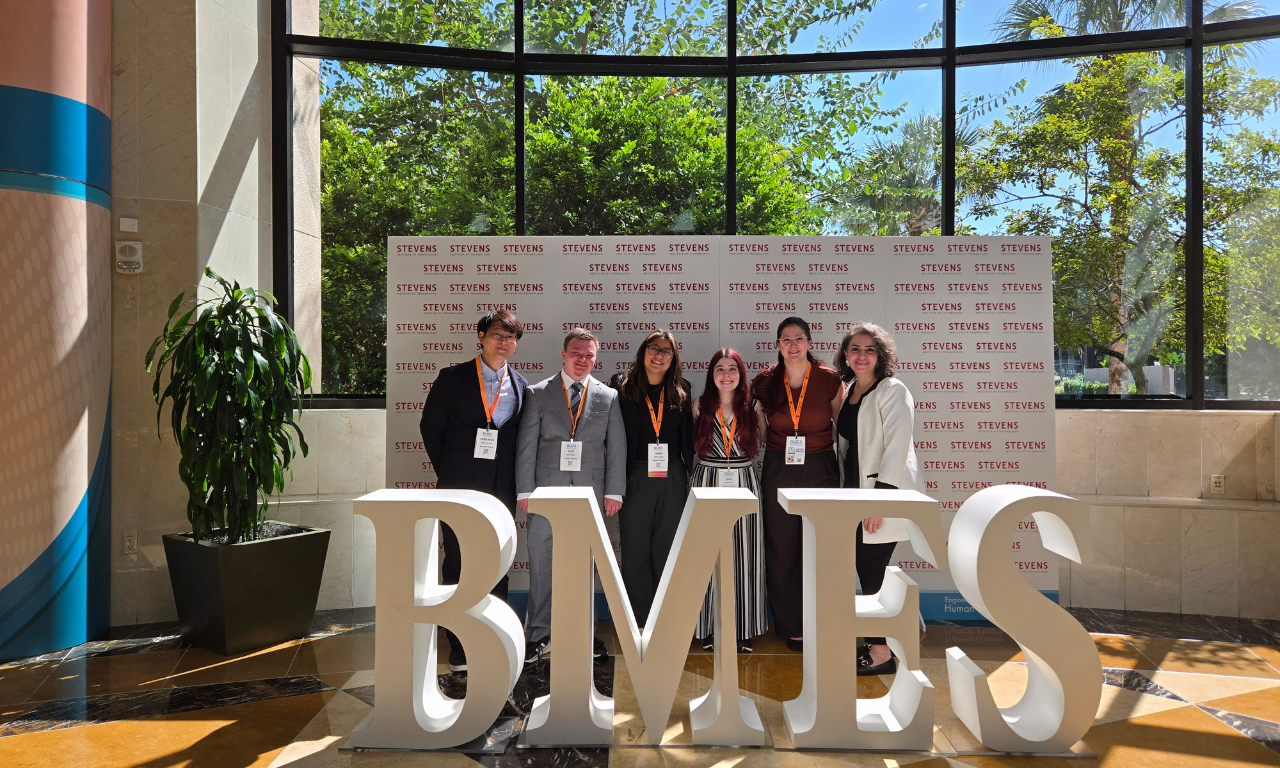
The students’ research was supported by faculty mentorship from Dr. Takafumi Asaki, who advised Georgia Brown; Dr. Solaleh Miar, who advised Jasmin Enriquez and Sofia P. Ferreira; and Dr. Seong Hyun Moon, who advised Ryan Vocaturo.
Dr. Moon also delivered an oral presentation titled “Assessment of Local Dynamic Stability across Inclined Self-Paced Walking Conditions Using Wearable IMUs,” examining walking stability under different treadmill speed and slope conditions.
These presentations reflect CETA’s commitment to undergraduate research, experiential learning, and preparing students to communicate their work within the broader biomedical engineering community.