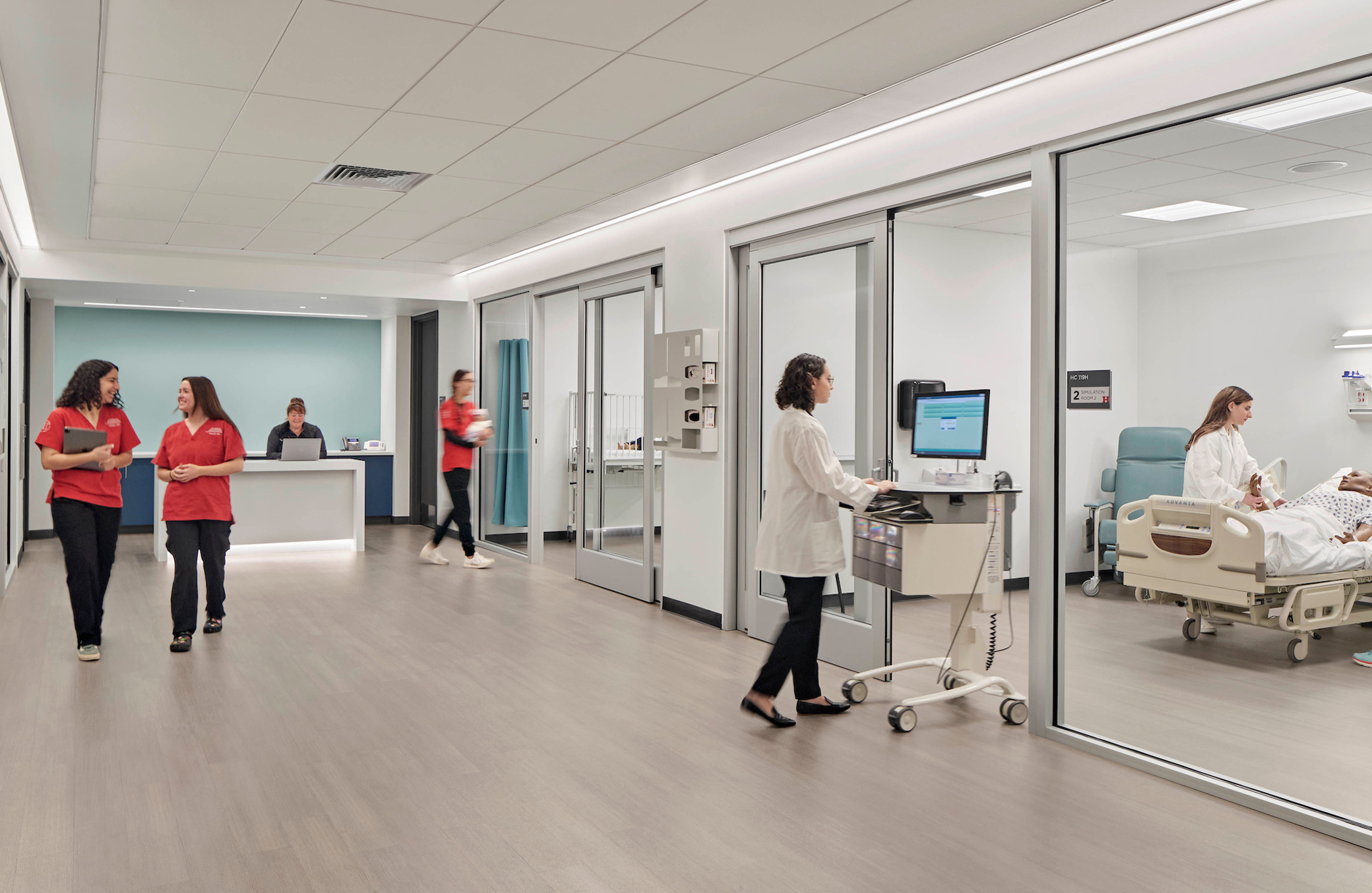
Edith Ouellet has been a nurse for more than 35 years. In most contexts, that number would never be considered a lifetime—but when talking about technology and educational resources, 35 years can be a gulf that separates one era from another.
“I saw nurse education evolve essentially from having one room with a manikin—and that's it—to a practice environment that's as real as it can get, where advanced knowledge, practical skills, and critical thinking are all part of the facility in which the discipline is being taught,” says Ouellet, the executive director and chair of the nursing department for the College of Education, Nursing and Health Professions (ENHP).
The facility she is referring to is the University of Hartford's Francis X. and Nancy Hursey Center for Advanced Engineering and Health Professions, a 60,000-square-foot building—a campus hub, as it is often described—that was carefully planned to meet the needs of dedicated, enthusiastic students and educators today and well into the future. Ouellet is one of hundreds of UHart educators, students, and staff members celebrating the Hursey Center's fifth anniversary.
Paul Slaboch, Professor and Chair; Director, Aerospace Engineering ProgramIt gives me a great sense of pride to show off this building to potential students, families, friends, collaborators, industry partners, or anybody else who expresses an interest. It's a wonderful thing that Frank and Nancy were able to see their passions fulfilled in a building that so seamlessly bridges engineering and health professions at UHart.
A half decade after opening its doors, the Hursey Center continues to fulfill the vision behind its creation, establishing itself as one of the region's premier destinations for nursing and engineering education. Thoughtfully designed to inspire collaboration and innovation, it brings together students and faculty from both ENHP and the College of Engineering, Technology, and Architecture (CETA) in an environment where learning extends far beyond the classroom through research, simulation, design, and discovery.
"When I first saw the Hursey Center, I could sense immediately that it was well designed for meeting all our needs and goals," says Kiwon Sohn, associate professor of electrical and computer engineering and director of the robotics engineering program at CETA. Sohn founded the school’s robotics lab and moved it into Hursey as soon as the Center opened. "As a roboticist who focuses on real-world problem-solving capabilities, the Hursey Center is ideal for me because it is equipped with such features as a makerspace, a machine shop, and a 3D printer lab. We are able to design, build, and program various types of robotic platforms, which include full-sized humanoids and quadrupeds.”
Among the many specialized pursuits, both in healthcare and engineering, that have a technological home at the Hursey Center are motion analysis, strength and conditioning, cybersecurity, occupational therapy, kinesiology, human performance, immersive simulation, and dozens of others. According to one of its architects, several goals went into the Center’s creation, in addition to supporting UHart's expanding health, engineering, and technology programs.
"We wanted to create a new campus crossroads where students and visitors could feel the creativity just by walking through the front door," says Tom Simister, a principal and director of space strategies for Payette, a Boston-based architectural firm. "Many universities set out to create projects like this, but few end up with a result that is as beloved and as well-used as the Hursey Center. When then-President Woodward encouraged our firm to locate the project right in the center of the academic green, we knew that the design had to be worthy of this unique location and become a nexus between two campus landscapes that each have their own character."
A Hub for In-Demand Programs

Brightness and open spaces are just two of many features Simister and his colleagues built into the Hursey Center. "I love all the natural light in my lab," notes Paul Slaboch, professor and chair of the mechanical, aerospace, and acoustical engineering department at CETA. Slaboch had a major role in helping to decide on the direction of the building's design and functionality. In addition to the light, he is thrilled with the dedicated lab space for wind tunnels and for extra-large project spaces, which benefit his students.
"There are high ceilings, open spaces, and a very collaborative feel," he says. "It gives me a great sense of pride to show off this building to potential students, families, friends, collaborators, industry partners, or anybody else who expresses an interest." Slaboch is also pleased that the building's primary patrons, the Hurseys, knew exactly what had been accomplished in their names prior to Nancy’s passing in October 2025. "It's a wonderful thing that Frank and Nancy were able to see their passions fulfilled in a building that so seamlessly bridges engineering and health professions at UHart," Slaboch says.
The Building's Namesake
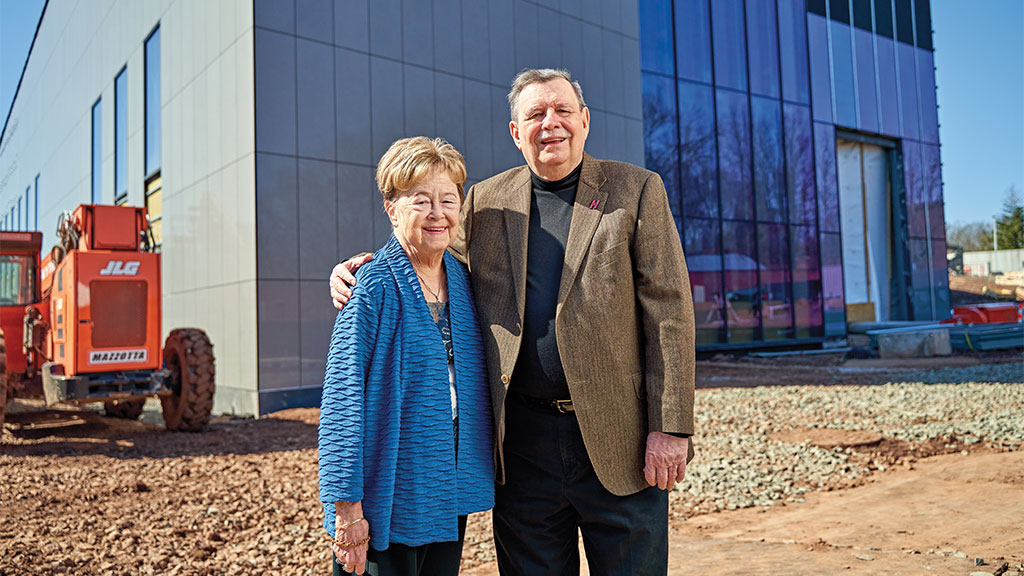
Frank Hursey A’73, ’77, who received a bachelor's degree in mechanical engineering at UHart after 12 years of night classes, was an inventor who created the QuikClot hemostatic agent that stops severe bleeding and is used by the military, law enforcement, and in hospital emergency rooms. He also worked on the Apollo program for NASA. His late wife, Nancy, was a nurse for 40 years who demonstrated an enduring passion both for the field of nursing and for helping people in need. She had suffered from diabetes as a child and spent much of her youth as a hospital patient, to which her passion for nursing can be traced. With her husband, she founded the Hursey Family Foundation to fund charitable causes, with UHart being one of its grateful beneficiaries.
Room to Grow.
The Hursey Center continues to be a highlight for tours by new and prospective students. It proves that a building with a serious purpose can nonetheless promote socialization and relaxation. Its location was selected to create a fluid matrix of gathering spaces around the building and across the quad. Another of its most noticeable features, its green roof, is both an aesthetic and sustainable way to blend the building with the surrounding environment.
Current nursing student Greta Currier says she was drawn to the simulation labs in the Hursey Center during her initial visit to campus before making her final college choice. "It's set up to feel like you're in a real hospital, with advanced technology to match," she shares. "I know other schools also have sim labs, but I feel that ours goes above and beyond—and, of course, we have amazing teachers on top of it all who make our program so successful."
Teachers, yes—many of whom are also scientists and researchers. "I have not just one, but two labs in the Hursey Center, and when I'm not teaching or doing office work, I'm working in one of those labs," says Song Wang, an assistant professor of civil, environmental, and biomedical engineering at CETA. Wang, who has written about the work he does in the building in highly respected journals, focuses his Hursey Center lab research on fiber-reinforced polymer and its application in reinforcing and repairing steel and concrete structures. "I've given many people tours of my lab and this facility, and I feel good when I see faces that are amazed and hear a lot of 'wows!' The Hursey Center makes this University stand out."
Simister, one of the architects, eagerly shares news of a post-occupancy survey of more than 200 students, faculty, and staff that his firm conducted. "95 percent of the respondents said that the building supports the way they want to teach and learn," he says. "Many point to the 'central street' that lets you see other disciplines at work as you move through the Center. More than a few students told us that the Hursey Center is the reason they chose UHart in the first place. That's the clearest signal that a building is doing its job. People don't just use it, they're proud of it."
Five years after opening its doors, the Hursey Center continues to fulfill the promise behind its creation. Through cutting-edge facilities, hands-on learning, and interdisciplinary collaboration, it has transformed the educational experience for countless students. As the University celebrates this milestone, the Center remains a place where innovation comes to life and where the future is being built every day.